
Goethe A1 Exam: How the 100 Points Really Work
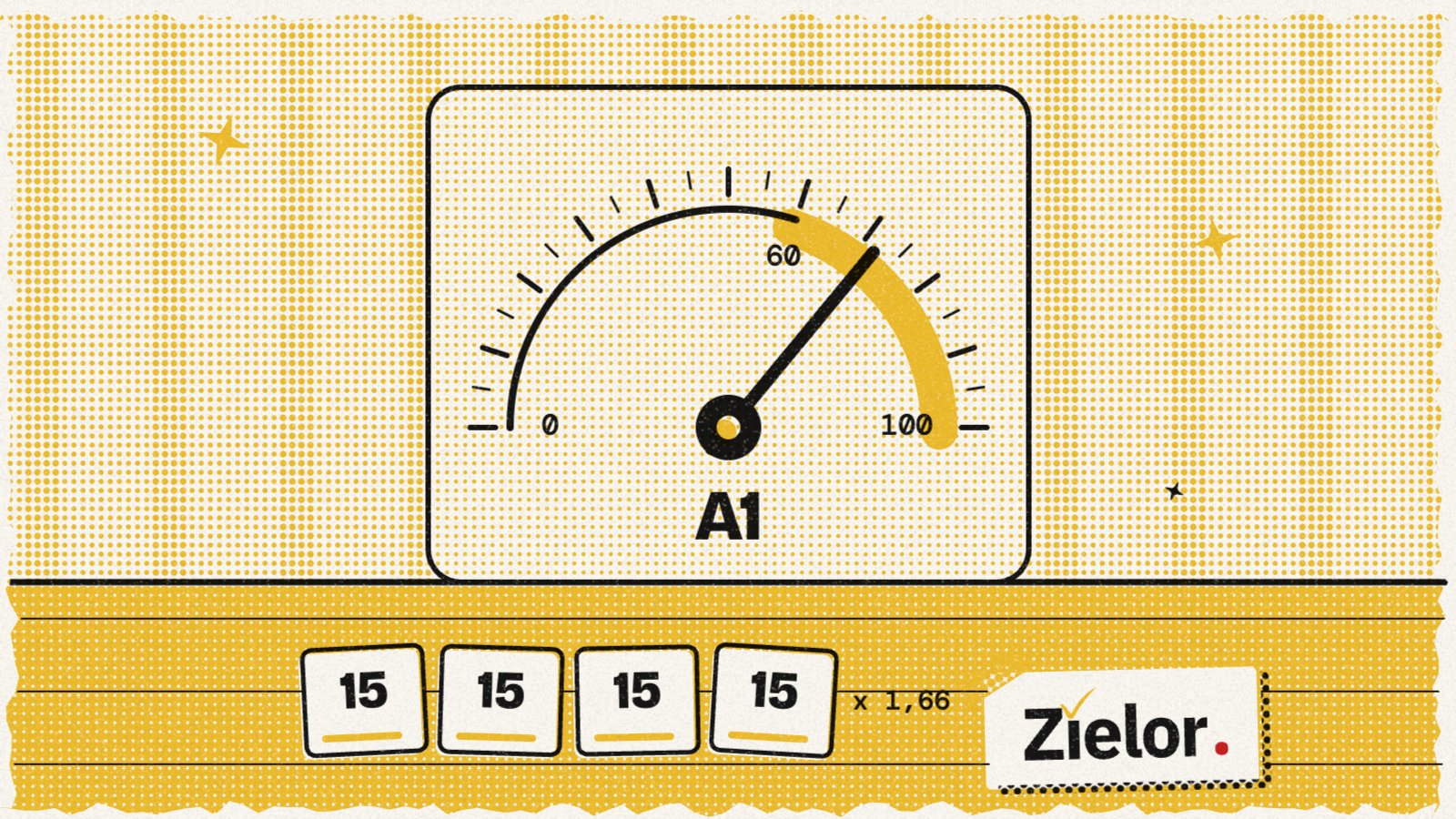
Goethe A1 scoring worked out: 15 raw points per part, times 1.66, 60 of 100 to pass. You need 36 of 60 raw points, so you can lose 24.
Read the transcript
To pass the Goethe A1 exam, Start Deutsch 1, you need 60 of 100 points. In practice, that means 36 of the 60 raw points on your answer sheets. So you can lose 24 raw points across the whole exam. Spread evenly, that is 6 per part. Start Deutsch 1 has four parts. Hören, Lesen and Schreiben, so listening, reading and writing, form one written exam of 65 minutes, with no break between them. The fourth part, Sprechen, is a separate speaking exam in a small group. Hören takes about 20 minutes and has 15 tasks. Lesen takes 25 minutes, also with 15 tasks. In Schreiben you have 20 minutes to fill 5 gaps in a form and write a short message of about 30 words. And Sprechen takes 15 minutes. A few details matter on the day. In Hören, parts 1 and 3 are played twice, but part 2 only once. You copy your answers onto the answer sheet at the end, inside your exam time, and only the answer sheet counts. And Sprechen has no preparation time. Up to four candidates sit together with two examiners. Every part ends at 15 raw points, but each part gets there in its own way. Hören and Lesen are simple. 15 tasks, 1 point for a right answer, 0 for a wrong one. There is no penalty for guessing, so never leave a box empty. Schreiben has two tasks. The form gives 1 point per correct gap, 5 in total. The short message is worth 10. Each of its three content points earns 3 points, 1.5 or nothing, and the text type earns the last point. Sprechen gives 3 points for part 1, and 6 each for parts 2 and 3. For every task, the examiners give full points, half points or nothing. Intelligibility decides, not the number of errors. In Schreiben and Sprechen, two people mark you separately. Their results are averaged and rounded to a whole point. If both graders give your message 6.5, you get 7. If one gives 6.5 and the other 5, the average is 5.75, and you get 6. Now the conversion. Section 6.1 of the regulations says the points from each part are multiplied by 1.66 and then added. Only the total is rounded to whole points. So one full part is worth 15 times 1.66. That is 24.9 points, not exactly 25. A perfect paper is 60 times 1.66, which is 99.6, and that rounds to 100. The rounding happens once, at the end. Your parts are never rounded one by one. That is why the raw point is the unit to plan with. The exam is passed with at least 60 points, as long as you took all four parts. 36 raw points times 1.66 is 59.76, which rounds up to 60. Passed. 35 raw points times 1.66 is 58.1, which rounds down to 58. Not passed. So the real pass line is 36 raw points out of 60. There is no minimum per part. Only the total counts. Let's work one through. Say you score 10 in Hören, 11 in Lesen, 8 in Schreiben and 7 in Sprechen. The raw sum is 36. Times 1.66, that is 59.76. Rounded, it is 60, and you pass. With 60 raw points available and 36 needed, you can lose 24. Spread evenly, you lose 6 in each part and keep 9 of 15. That is a useful target for your first mock exam. Spread unevenly, the budget moves. A strong listener with 14 in Hören can drop to 9 in Lesen, 7 in Schreiben and 6 in Sprechen, and still reach 36. And someone with only 5 in Schreiben can still pass with 11, 12 and 8 in the other three parts. Still, the even target is safer. A bad day in one part is then covered by the others. Section 6.3 adds a second rule. If you score fewer than 35 of the 75 written points, even full points in Sprechen can no longer bring you to 60. In raw points, the floor is 21 of the 45 written points. With 21 written and a perfect 15 in Sprechen, you reach exactly 36. That is a pass. With 20 written, even a perfect Sprechen only brings you to 35, which is 58. Two details make this less scary. The binding German text calls taking Sprechen at that point pointless, not forbidden. And you usually will not know your written score before the speaking exam anyway. So take Sprechen as planned, and give it everything. The certificate also shows a grade, and each band converts neatly into raw points. A pass starts at 36. Satisfactory starts at 42. Good starts at 48. And very good starts at 54. Each band is exactly 6 raw points wide, because 6 raw points are worth 9.96 points after the factor. If you want the grade good, your target is 48 raw points. That means losing no more than 3 per part on average. Schreiben and Sprechen are where points slip away. The marking rewards completed tasks, not fancier German. In the Schreiben message, the three content points carry 9 of the 10 points. A missing content point costs 3 raw points at once, which is about 5 points on your final score. A greeting and a closing are cheap insurance for the last point. And there is no bonus for writing more than about 30 words. In Sprechen, half points go to tasks that are only partly done. Wrong word stress, wrong word order and unsuitable word choice can all make you harder to understand. So practise short, clear questions and answers until they come without hesitation. Start Deutsch 1 is not modular. You can only retake it as a whole, but you can retake it as often as you like. If you fail, ask for a confirmation of participation that shows your points. It tells you which part cost you the most. For a family visa, German residence law says a joining spouse must, as a rule, be able to communicate in German in a simple way. The law defines that as level A1. There are exceptions, and whether one applies to you is a question for the German mission handling your visa. Now turn the numbers into a plan. First, take one full official model exam early, under time, including the transfer to the answer sheet. Second, find your raw total, not just your feeling. Third, aim for 9 of 15 in every part as the minimum. Fourth, drill the Schreiben scheme. Three content points, a greeting, a closing, about 30 words. And fifth, practise Sprechen out loud with someone, because there is no preparation time on the day. Do not trust a result that looks close. Take 9 in Hören, 9 in Lesen, 9 in Schreiben and 8 in Sprechen. But the raw total is 35, and 35 gives 58. Every raw point is worth 1.66 on the final score, and at the edge, one answer decides. So count raw points, and plan for more than 36. To sum up. Four parts, 15 raw points each. Every raw point is multiplied by 1.66, and only the total is rounded. You need 36 of 60 raw points for the pass mark of 60. That leaves 24 points to lose, or 6 per part. The full guide, with every source, is on zielor.com. You can join the waitlist there too, if you want to know when the Zielor app opens. Zielor is independent and not affiliated with the Goethe-Institut.
On this page
- What the Goethe A1 Exam Looks Like
- How Each Part Is Scored
- From Raw Points to 100: The 1.66 Rule
- The Pass Line in Raw Points: 36 of 60
- How Many Points You Can Afford to Lose per Part
- The Written Checkpoint: 35 Points
- Grades on the Certificate
- Where Points Go Missing in Schreiben and Sprechen
- If You Do Not Pass
- A1 and the Spouse Visa
- A Study Plan Built on the Numbers
- Sources
To pass the Goethe A1 exam (Goethe-Zertifikat A1: Start Deutsch 1) you need 60 of 100 points, and in practice that means 36 of the 60 raw points on your answer sheets. Each of the four parts gives 15 raw points, every raw point is multiplied by 1.66, and only the total is rounded. So you can lose 24 raw points across the whole exam, which is 6 per part if you spread them evenly.
That is the whole rule. The rest of this guide shows where each of those numbers comes from in the official Durchführungsbestimmungen (the Goethe-Institut's exam regulations for A1, in force since 1 September 2025), and what they mean for how you prepare.
Key numbers
Goethe A1 scoring in four numbers
Four key numbers of the Goethe A1 score: 60 raw points maximum, 1.66 factor, 36 raw points to pass, 24 raw points you can lose.
60
Raw points in total
15 in each of the 4 parts
1.66
Factor per raw point
Total rounded to whole points
36
Raw points to pass
36 x 1.66 = 59.76, rounds to 60
24
Raw points you can lose
6 per part if spread evenly
Read this figure as text
The Goethe-Zertifikat A1: Start Deutsch 1 has four parts worth 15 raw points each, 60 raw points in total. Each raw point is multiplied by 1.66 and the total is rounded to whole points. 36 raw points give 59.76, which rounds to 60, the pass mark. That leaves a budget of 24 raw points you can lose across the whole exam.
What the Goethe A1 Exam Looks Like
Start Deutsch 1 has four parts. Three of them, Hören (listening), Lesen (reading) and Schreiben (writing), are a written exam of 65 minutes with no break between them. The fourth, Sprechen (speaking), is a separate oral exam in a small group.
Exam structure
Goethe A1 exam structure: four parts, 100 points
Structure of the Goethe A1 exam: Hören, Lesen and Schreiben in a 65 minute written exam, then a 15 minute group speaking exam, each part worth 25 points.
Share of the time per part
-
Hören (Listening)
- Items
- 15
- Minutes
- 20
- Points
- 25
3 parts, about 20 minutes, 15 raw points
-
Lesen (Reading)
- Items
- 15
- Minutes
- 25
- Points
- 25
3 parts, 15 raw points
-
Schreiben (Writing)
- Items
- 2
- Minutes
- 20
- Points
- 25
Form (5 points) and short message (10 points)
-
Sprechen (Speaking)
- Minutes
- 15
- Points
- 25
3 parts worth 3 + 6 + 6, groups of up to 4, no preparation time
Total80 Minutes100 Points
Read this figure as text
Hören has 3 parts with 15 tasks and takes about 20 minutes. Lesen has 3 parts with 15 tasks and takes 25 minutes. Schreiben has 2 tasks, a form with 5 gaps and a short message of about 30 words, and takes 20 minutes. The written exam runs 65 minutes without a break. Sprechen is a group exam for up to 4 candidates, 15 minutes long, with 3 parts and no preparation time. Each part carries 25 of the 100 points (exactly 24.9 before rounding).
As of 28 September 2026, the official timing and content are as follows.
| Part | What you do | Time | Raw points |
|---|---|---|---|
| Hören | 3 parts, 15 tasks. Short conversations, public announcements, phone messages | about 20 minutes | 15 |
| Lesen | 3 parts, 15 tasks. Short notes or emails, small ads, signs and notices | 25 minutes | 15 |
| Schreiben | Fill 5 gaps in a form, then write a short message of about 30 words | 20 minutes | 15 |
| Sprechen | Introduce yourself, ask and answer questions, make requests | 15 minutes | 15 |
A few details from the regulations are worth knowing before exam day:
- Listening repeats are uneven. In Hören, the texts in Teil 1 and Teil 3 (parts 1 and 3) are played twice, but in Teil 2 you hear each announcement only once (Prüfungsziele, Testbeschreibung).
- Transfer time is inside the exam time. You mark answers on the task sheets first and copy them onto the answer sheet at the end. About 5 minutes are planned for this after Hören and another 5 after Lesen and Schreiben, and they come out of your exam time, not on top of it.
- Only the answer sheet counts. For Schreiben Teil 2 you write straight onto the answer sheet, and only that final copy is marked.
- No dictionaries in any written part.
- Sprechen has no preparation time. Up to four candidates sit together with two examiners, one of whom moderates. Each of the three parts takes about 5 minutes. If you are the only candidate, an examiner takes the partner's role.
- Written and oral may be on different days, but then at most 14 days apart.
- Digital exams exist. Some centres run the written parts on a centre laptop with a German keyboard. The content is the same as on paper, and there is no answer sheet to copy onto.
There is no strict minimum age. The Prüfungsordnung recommends Start Deutsch 1 for people aged 16 and over (section 3.1), and you do not need to have attended a course. The fee is not set centrally. The Prüfungsordnung (the Goethe-Institut's general exam rules) says it follows the local fee schedule of each exam centre, so check your centre's registration form.
How Each Part Is Scored
Every part ends up at 15 raw points, but the parts get there in different ways. This matters, because "15 points" in Lesen and "15 points" in Sprechen are earned very differently.
Comparison
How each part of the Goethe A1 is marked
Table comparing how Hören, Lesen, Schreiben and Sprechen are marked in the Goethe A1 exam.
| Row | Hören | Lesen | Schreiben | Sprechen |
|---|---|---|---|---|
| Raw points | 15 | 15 | 15 | 15 |
| Split | 15 tasks | 15 tasks | Form 5, message 10 | Parts 3, 6, 6 |
| Per task | 1 or 0 | 1 or 0 | Form 1 or 0; message 3, 1.5 or 0 per content point | Full, half or 0 |
| Marked by | Answer key | Answer key | Two graders, averaged, rounded | Two examiners, averaged, rounded |
| Worth after x 1.66 | 24.9 | 24.9 | 24.9 | 24.9 |
Read this figure as text
Hören and Lesen each have 15 tasks at 1 or 0 points. Schreiben gives 5 points for the form and 10 for the short message, where each of three content points earns 3, 1.5 or 0 and the text type earns 1, 0.5 or 0; two graders are averaged and rounded. Sprechen gives 3, 6 and 6 points for its three parts, with full, half or no points per task, from two examiners averaged and rounded. Every part ends at 15 raw points, worth 24.9 after the factor 1.66.
Hören and Lesen are simple. 15 tasks, 1 point for a right answer, 0 for a wrong one. There are no half points and no penalty for guessing, so never leave a box empty.
Schreiben has two tasks. The form in Teil 1 gives 1 point per correct gap, 5 in total. The short message in Teil 2 is worth 10, and it is marked on a fixed scheme:
- each of the three content points you are asked to cover earns 3 points (done and understandable), 1.5 (only partly done because of language or content problems) or 0;
- the text type earns 1 point if it reads like a real message, 0.5 if typical phrases such as a greeting are missing or odd, and 0 if there are none.
Spelling mistakes only cost points when they get in the way of understanding. Two graders mark Teil 2 separately, their results are averaged, and the average is rounded to a whole point (up to .49 rounds down, from .5 rounds up). If both graders give you 6.5, you get 7. If one gives 6.5 and the other 5, the average is 5.75 and you get 6.
Sprechen gives 3 points for Teil 1 and 6 each for Teil 2 and Teil 3. For every task the examiners can give full points, half points or nothing. The official test description is explicit that intelligibility decides, not the number of errors. A sentence that is not fully correct can still earn full points if the listener understands it straight away. Two examiners rate you separately, and their ratings are averaged and rounded the same way as in Schreiben.
From Raw Points to 100: The 1.66 Rule
Section 6.1 of the regulations says the points from each part are multiplied by 1.66 and then added, and the total is rounded to whole points.
Two things follow from that sentence.
First, one full part is worth 15 x 1.66 = 24.9 points, not exactly 25. The regulations round this themselves when they say the exam has "75 points in the written part and 25 points in the oral part". Strictly, the figures are 74.7 and 24.9. A perfect paper is 60 x 1.66 = 99.6, which rounds to 100.
Second, the rounding happens once, at the end. Your parts are not rounded one by one. That is why the useful unit for planning is the raw point, and why the pass line sits at a raw number that looks odd at first.
The Pass Line in Raw Points: 36 of 60
The exam is passed with at least 60 points, provided you took all four parts.
- 36 raw points x 1.66 = 59.76, which rounds up to 60. Passed.
- 35 raw points x 1.66 = 58.1, which rounds down to 58. Not passed.
So the real pass line is 36 raw points out of 60. There is no minimum per part in the A1 regulations. It is only the total that counts, as long as every part was taken. Goethe B1 and the higher levels work differently, because they are modular and each module is certified on its own, so do not carry over rules you heard about B1.
Try your own numbers here. The calculator adds your raw points, multiplies by 1.66 and rounds the total, exactly as section 6.1 describes.
Score calculator
Goethe A1 score calculator
Score calculator: enter raw points for Hören, Lesen, Schreiben and Sprechen, each out of 15, to see the score out of 100.
Worked example
| Part | Points | Max |
|---|---|---|
| Hören | 10 | 15 |
| Lesen | 11 | 15 |
| Schreiben | 8 | 15 |
| Sprechen | 7 | 15 |
- Raw points
- 36
- times 1.66
- 59.76
- Score, rounded
- 60 of 100
60of 100
Pass mark 60
Passed
Read this figure as text
Enter your raw points for each part, from 0 to 15. The calculator adds them, multiplies the sum by 1.66 and rounds the total to whole points, as the Goethe regulations describe. 60 or more is a pass. The worked example uses 10 in Hören, 11 in Lesen, 8 in Schreiben and 7 in Sprechen: 36 raw points, 59.76, rounded to 60, a pass.
As of 28 September 2026, these worked examples show how the rule plays out:
| Hören | Lesen | Schreiben | Sprechen | Raw total | x 1.66 | Score | Result |
|---|---|---|---|---|---|---|---|
| 10 | 11 | 8 | 7 | 36 | 59.76 | 60 | Passed |
| 9 | 9 | 9 | 8 | 35 | 58.1 | 58 | Not passed |
| 14 | 9 | 7 | 6 | 36 | 59.76 | 60 | Passed |
| 11 | 12 | 5 | 8 | 36 | 59.76 | 60 | Passed |
| 12 | 13 | 10 | 13 | 48 | 79.68 | 80 | Passed (gut, good) |
The second row is the one that hurts. Four parts at 9, 9, 9 and 8 look almost identical to a pass, and they miss it by a single raw point. Every raw point is worth 1.66 on the final score, and at the edge one answer decides.
How Many Points You Can Afford to Lose per Part
With 60 raw points available and 36 needed, you can lose 24. How you spend that budget is up to you.
Spread evenly, you can lose 6 points in each part and keep 9 of 15. I think that is the most useful target for a first mock exam, 9 right in Hören, 9 in Lesen, 9 in Schreiben and 9 in Sprechen.
Spread unevenly, the budget moves. A strong listener who gets 14 in Hören can afford to drop to 9 in Lesen, 7 in Schreiben and 6 in Sprechen and still reach 36. Someone whose writing is weak (5 of 15) can still pass with 11, 12 and 8 in the other three parts. Those are rows three and four of the table above.
In theory one part could absorb the whole budget. If Hören, Lesen and Schreiben together bring 36 of their 45 raw points, the total is already 36 whatever happens in Sprechen. But you still have to take Sprechen, because a pass requires all parts to be taken. I would not plan around a weak part anyway. The even target is safer because a bad day in one part is then covered by the others.
I see Hören and Lesen as the parts where points are easiest to count, because an answer is simply right or wrong. They are the best place to build a cushion. Schreiben Teil 1 (the form) is 5 nearly free points if you read the situation text carefully, since the information you need is in the introduction.
The Written Checkpoint: 35 Points
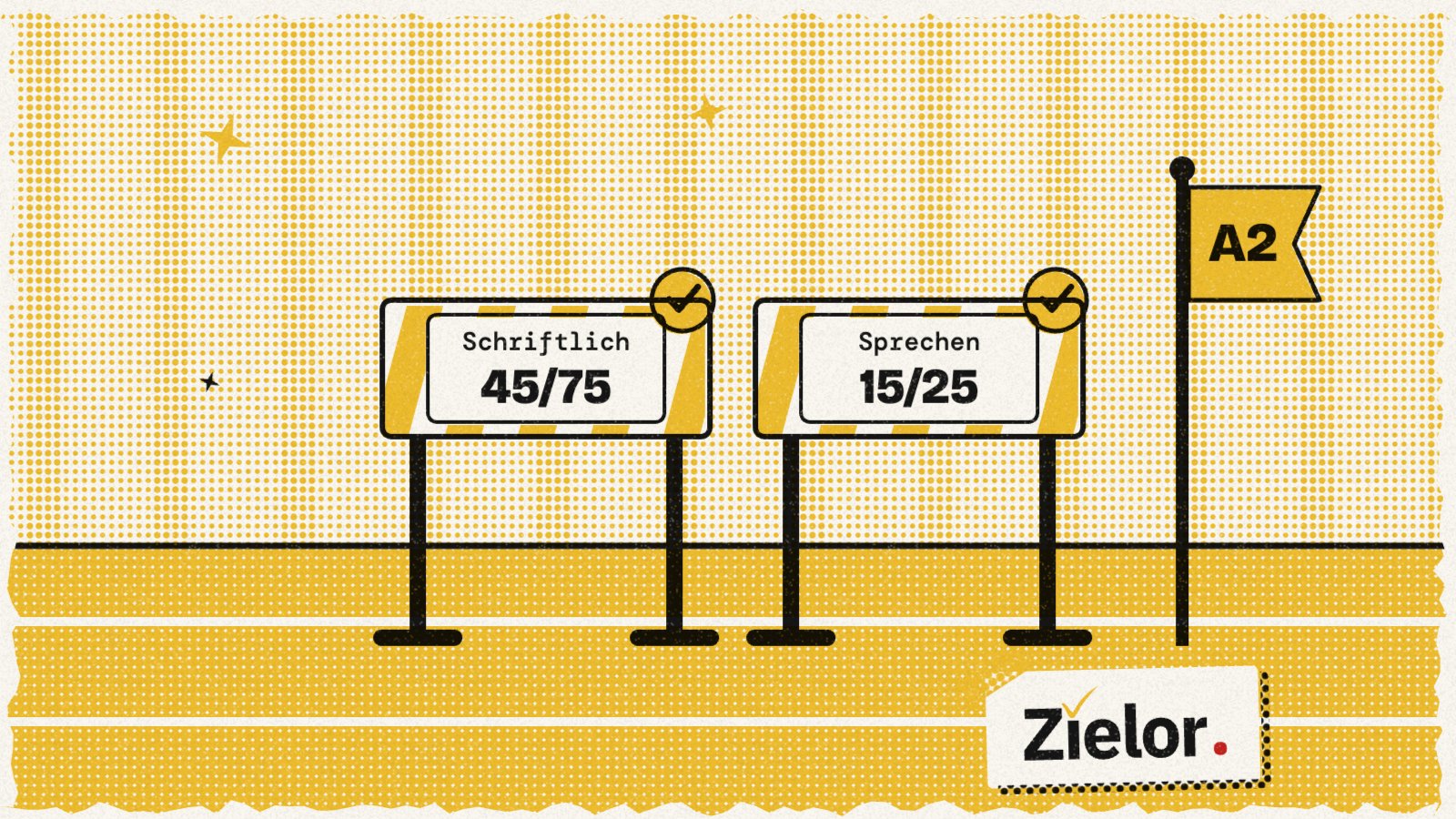
Section 6.3 adds a second rule. If you score fewer than 35 of the 75 points in the written part (Hören, Lesen and Schreiben after the x 1.66 factor), taking Sprechen "is not meaningful", because even full points in Sprechen can no longer bring you to 60.
In raw points, the floor is 21 of the 45 written points. With 21 written and a perfect 15 in Sprechen you reach exactly 36, which is a pass. With 20 written and a perfect Sprechen you reach 35, which is 58. So 20 or fewer raw points in Hören, Lesen and Schreiben together cannot be rescued. Strictly, 21 raw written points are 34.86 points, just under the 35 in section 6.3, because the regulation's 35 uses the rounded 75/25 split. That is one more reason the German wording below matters. With 21 written raw points you can still reach 60.
Pass rule
Did you pass the Goethe A1? The rule in three questions
Decision flow for the Goethe A1 result: all four parts taken, at least 21 written raw points, at least 36 raw points in total.
-
Did you take all four parts?
NoNot passed
A pass needs 60 points and all parts taken
Yes -
At least 21 of 45 raw points (34.86 points) in the written part?
NoNot passed
With 20 or fewer, even 15 in Sprechen cannot reach 60
Yes -
At least 36 of 60 raw points in total?
YesPassed
36 x 1.66 = 59.76, rounded to 60 or more
NoNot passed
35 raw points give 58; the pass line is 36
Read this figure as text
First, you must take all four parts; otherwise the exam is not passed. Second, the written part needs at least 21 raw points out of 45, because with 20 or fewer even a perfect Sprechen score cannot reach 60. The regulations put this checkpoint at 35 written points; in exact raw terms the last passable written score is 21 raw (34.86). Third, the total must reach 36 raw points out of 60, which is 59.76 and rounds to 60. With 35 raw points the score is 58 and the exam is not passed.
Two details make this rule less scary than it sounds.
The German text, which is the binding version according to section 8 of the regulations, calls taking Sprechen at that point "nicht sinnvoll", meaning pointless, not forbidden. The English column of the same document is stricter and says the candidate "shall not be allowed to move on". If this ever matters to you, the German wording is the one that applies.
And in most cases you will not know your written score before the oral exam anyway. The regulations say the written results are not passed on to the Sprechen examiners. Take Sprechen as planned and give it everything.
Grades on the Certificate
Passing is one thing. The certificate also shows a grade (Prädikat), and the bands convert neatly back into raw points.
Chart
Raw points needed for each Goethe A1 grade
Bar chart of the lowest raw score, out of 60, for each grade: 36 for ausreichend, 42 for befriedigend, 48 for gut, 54 for sehr gut.
Values in Lowest raw score out of 60
- ausreichend (60 to 69)36
- befriedigend (70 to 79)42
- gut (80 to 89)48
- sehr gut (90 to 100)54
Read this figure as text
Converting the official grade bands back to raw points out of 60: ausreichend (60 to 69 points) starts at 36 raw points, befriedigend (70 to 79) at 42, gut (80 to 89) at 48 and sehr gut (90 to 100) at 54. Each grade band is exactly 6 raw points wide, because 6 raw points are worth 9.96 points after the factor 1.66.
As of 28 September 2026, the official bands and their raw equivalents are:
| Score | Prädikat | Meaning | Raw points out of 60 |
|---|---|---|---|
| 90 to 100 | sehr gut | very good | 54 to 60 |
| 80 to 89 | gut | good | 48 to 53 |
| 70 to 79 | befriedigend | satisfactory | 42 to 47 |
| 60 to 69 | ausreichend | pass | 36 to 41 |
| 0 to 59 | nicht bestanden | fail | 0 to 35 |
Each band is exactly 6 raw points wide, because 6 raw points are worth 9.96 points after the factor. So every 6 extra raw points move you up one grade, and 6 fewer move you down one. If a pass is all you need, 36 is your number. If you want "gut", your target is 48 raw points, which means losing no more than 3 per part on average.
Where Points Go Missing in Schreiben and Sprechen
The two productive parts are where candidates lose points without noticing, because the marking rewards completed tasks and gives nothing extra for longer or fancier German.
In Schreiben Teil 2, the three content points carry 9 of the 10 points. A short, plain message that answers all three is worth more than a long, fluent one that forgets the third point. A missing content point costs 3 points at once, which is about 5 points (4.98) on your final score. The last point is for the text type, so a greeting and a closing formula are cheap insurance. About 30 words is the expected length. There is no bonus for writing more.
In Sprechen, half points are given when a task is only partly done because of language or content problems. The examiners ask themselves whether you understood the question or request, whether you phrased your own appropriately, and how understandable you were. The test description names wrong word stress, wrong word order and unsuitable word choice as things that can reduce intelligibility. So I would practise short, clear questions and answers on everyday topics until they come without hesitation, rather than learning long memorised speeches.
If You Do Not Pass
Start Deutsch 1 is not modular. According to the regulations it can only be retaken as a whole, and the Prüfungsordnung allows that as often as you like. The exam centre may set time periods for resit dates and will tell you about them with your result. There is no legal right to a specific date.
Some practical points from the Prüfungsordnung:
- Results come from the exam centre where you took the exam. Individual early results are not possible.
- If you fail, you can ask for a confirmation of participation that shows your points. Use it to see which part cost you the most raw points.
- Within three months of the results you can apply to inspect your answers and marks. The tasks and model answers themselves are not shown.
- Certificates are issued on paper or digitally, depending on the centre, and can be verified at goethe.de/verify.
A1 and the Spouse Visa
If you are taking A1 for a family visa, this is the legal background. German residence law says a spouse joining a foreign resident in Germany must, as a rule, be able to communicate in German "in a simple way" (§ 30 AufenthG), and the law defines simple German knowledge as level A1 (§ 2 Abs. 9 AufenthG). The same section lists exceptions, and whether one applies to you is a question for the German mission handling your visa, not for this guide.
A Study Plan Built on the Numbers
If I were preparing for Start Deutsch 1 with limited time, I would use the scoring rules to decide where the hours go.
- Take one full official model exam early, under time, including the answer sheet transfer. The Goethe-Institut publishes a free Modellsatz (model exam) and further practice sets. Score it with the calculator above.
- Find your raw total, not just your feeling. Below 36 means you know how many raw points you still need. At 36 to 41 you pass on a good day, but one bad part can sink you.
- Aim for 9 of 15 in every part as the minimum, then build a cushion in whichever of Hören and Lesen comes easier to you.
- Drill the Schreiben scheme. Three content points, a greeting, a closing, about 30 words. It is the most predictable 10 points in the exam.
- Practise Sprechen out loud with someone, because there is no preparation time on the day. Spelling your name and saying numbers (Teil 1) is easy to practise and easy to lose points on.
Zielor is a German exam trainer in development, built around exactly this kind of scoring logic. It is not connected to the Goethe-Institut. If you would like to try it when it opens, you can join the waitlist on this site.
How this article was made: drafted with AI assistance from the official documents linked above and checked by Kevin Gabeci.
Sources
- Goethe-Institut, Durchführungsbestimmungen Goethe-Zertifikat A1: Start Deutsch 1, Stand 1 September 2025: https://www.goethe.de/pro/relaunch/prf/de/Durchfuehrungsbestimmungen_A1_Start_Deutsch_1.pdf
- Goethe-Institut, Goethe-Zertifikat A1: Start Deutsch 1, Prüfungsziele, Testbeschreibung (2019 edition): https://www.goethe.de/pro/relaunch/prf/de/Pruefungsziele_Testbeschreibung_A1_SD1.pdf
- Goethe-Institut, Prüfungsordnung, Stand 1 September 2025: https://www.goethe.de/pro/relaunch/prf/de/Pruefungsordnung.pdf
- Goethe-Institut, Start Deutsch 1 Modellsatz: https://www.goethe.de/pro/relaunch/prf/materialien/A1_sd1/sd_1_modellsatz.pdf
- Goethe-Institut, certificate verification: https://www.goethe.de/verify
- Aufenthaltsgesetz § 30 (spouse reunification): https://www.gesetze-im-internet.de/aufenthg_2004/__30.html
- Aufenthaltsgesetz § 2 (definitions of language levels): https://www.gesetze-im-internet.de/aufenthg_2004/__2.html