
Goethe A2 Exam: The Two Pass Lines You Have to Clear
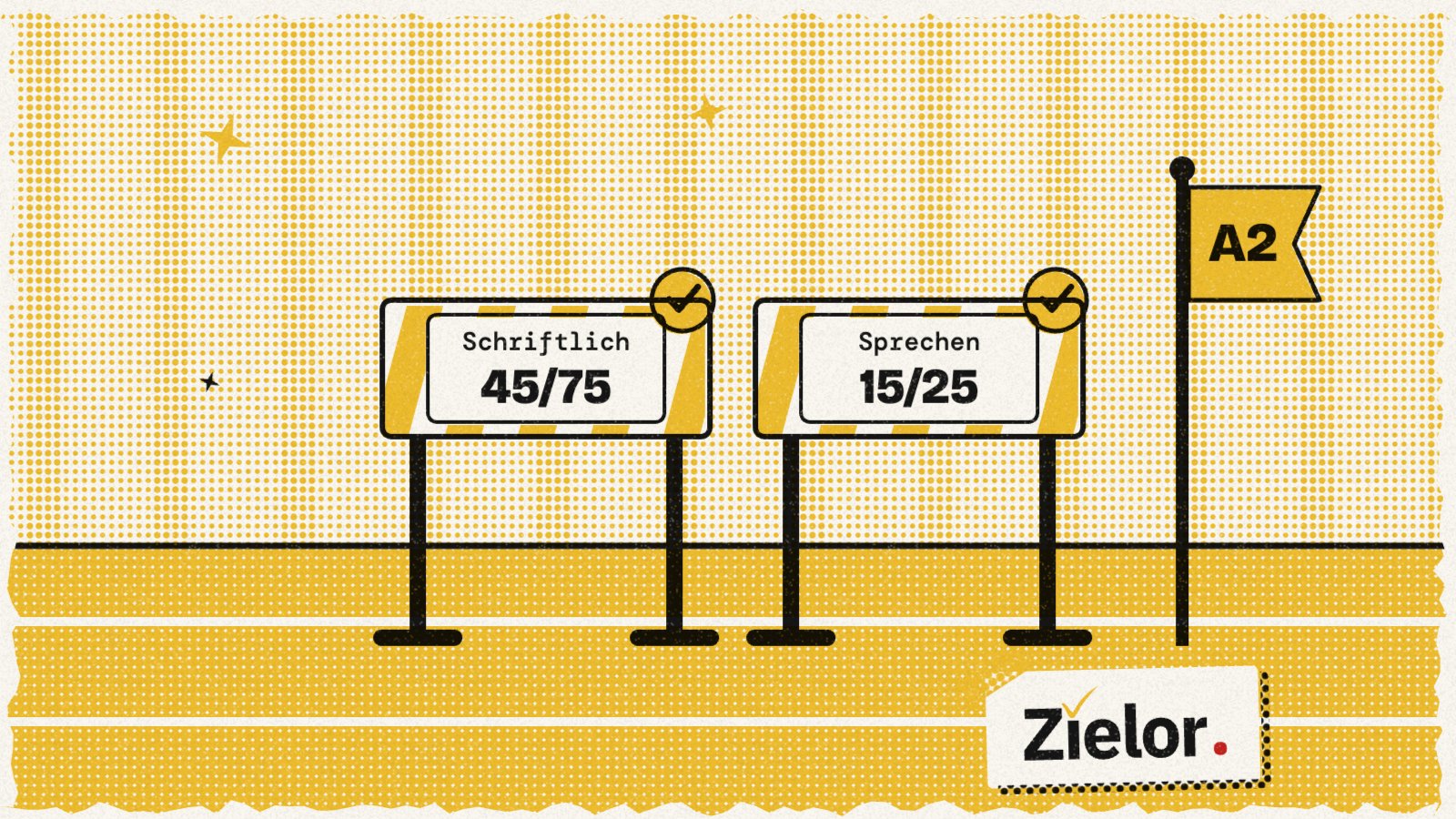
To pass Goethe A2 you need 45 of 75 written points and 15 of 25 in Speaking, both lines. In raw terms that is 36 of 60 written points.
Read the transcript
To pass the Goethe A2 exam, you need two things. At least 45 of 75 points in the written exam, and at least 15 of 25 points in Speaking. Both lines have to be cleared. In raw terms, the written line means 36 of 60, because every raw point is multiplied by 1.25. A strong written result cannot make up for a weak Speaking result. So it is possible to score 75 of 100, and still fail. Four numbers sum it up. 45 of 75 written points. 15 of 25 Speaking points. 36 of 60 raw written points. And a factor of 1.25 per raw point. A2 is not modular. You sit two compulsory components. The written exam has Lesen, or Reading, with 20 items in 30 minutes. Hören, or Listening, with 20 items in about 30 minutes. And Schreiben, or Writing, with 2 short texts in 30 minutes. Then Sprechen, or Speaking, takes 15 minutes for a pair. Each part is worth 25 points. The written exam takes 90 minutes with no breaks. A few details are easy to miss. In Listening, the texts in parts 2 and 3 are played only once. You get about 3 minutes in Reading and in Listening to copy your answers onto the answer sheet, and only that sheet is graded. And Speaking has no preparation time. Every part ends up at 25 points, but three of them start at 20 raw points. Reading and Listening give one point per correct answer, with no penalty for wrong ones. The raw score is multiplied by 1.25, so 20 correct answers give 25. Writing gives each text up to 5 points for task fulfilment, and up to 5 for language. That makes 20 raw points. Two graders' totals are averaged, rounded, and multiplied by 1.25. One rule can wipe out a task. With fewer than 10 words in the text message, fewer than 15 in the e-mail, or a text that misses the topic, that text scores 0. The targets are 20 to 30 words, and 30 to 40 words. Speaking has no conversion. Part 1, questions about yourself, is worth 4 points. Part 2, talking about your life, is worth 8. Part 3, planning something together, is worth 8. And pronunciation adds 5. Two examiners score you, and their totals are averaged and rounded. The rule is in section 6.3 of the Terms and Conditions. You pass with at least 60 points and all sections completed, and within that, 45 of 75 written and 15 of 25 in Speaking. 45 plus 15 is exactly 60. So once you clear both lines, the 60 comes automatically. The two minimums do all the work. Here is the check, in order. Did you take both parts? If not, you have not passed. Do you have at least 36 raw written points? If not, even 25 in Speaking cannot help. And do you have at least 15 in Speaking? If yes, you pass. If not, a strong written part cannot make up for it. Let's work one example. Say you score 13 in Reading, 12 in Listening, and 11 in Writing. That is 36 raw points. 36 times 1.25 is 45, so the written line is cleared, just. With 35 raw points, you get 43.75, and it is not cleared, whatever you score in Speaking. So you can lose 24 raw points across the three sections together. There is no minimum in each section, so a weak Writing result can be carried by strong Reading and Listening. Speaking stands on its own, and nothing from the written exam carries into it. Band B on every criterion gives 18.5 points, which is a pass. Band C on every criterion gives 12, which is a fail. And parts 2 and 3 carry 16 of the 25 points. Now put the two lines together. In the first example, 36 raw written points give 45, plus 15 in Speaking. That is 60, a pass. In the second, 49 raw points give 61.25, plus 14 in Speaking. That rounds to 75, and it is not passed, because Speaking is one point short. In the third, 35 raw points and a perfect 25 in Speaking. That is 69, and not passed. In the fourth, 45 raw points give 56.25, plus 19. That is 75 again, and a satisfactory pass. The grade comes from the rounded total. 90 to 100 is very good, 80 to 89 is good, 70 to 79 is satisfactory, and 60 to 69 is a pass. For good, you need 80 in total. One way there is 48 raw written points, which give 60, plus 20 in Speaking. A2 is repeated as a whole, as often as you like. In exceptional cases, and only if the centre can organise it, you may resit just the oral exam or the entire written exam. That is possible only within a year, and only at the same centre. So if you missed only one line, ask your centre before you book the whole exam again. And if you fail, ask for a confirmation of participation. It shows your points, and which line you missed. A2 sits between two exams that work differently. From A1, it keeps one single exam, and a fixed factor per raw point. From B1, it borrows the pair format in Speaking, and the idea that a weak skill cannot hide behind a strong one. At B1, each module is passed on its own, and you retake only the failed module. German law calls A2 adequate German. The visa for recognition measures asks, as a rule, for at least A2. The opportunity card gives 1 point for A2 German, and you need at least 6 points in total. And A2 is more than the spouse visa asks for, which is A1 as a rule. The common mistake is to relax about Speaking after a good written mock. Speaking is the line that can fail you with 75 points on the board. Set your written target at 40 raw points, not 36, and train Speaking with a partner, out loud. To sum up. There are two lines, 45 of 75 written, and 15 of 25 in Speaking. The written line is 36 raw points. Neither part can rescue the other. And a total of 75 can still fail. The full guide, with the calculator and every official source, is on zielor.com. You can join the waitlist there, to hear when the Zielor app opens. Zielor is independent and not affiliated with the Goethe-Institut.
On this page
- What the Goethe A2 Exam Looks Like
- How Each Part Is Scored
- The Two Pass Lines
- The Written Line in Raw Points: 36 of 60
- The Speaking Line: 15 of 25
- Why 75 Points Can Still Be a Fail
- Grades on the Certificate
- If You Do Not Pass
- A1, A2 and B1 Compared
- What Goethe A2 Is Used For
- Booking From India
- A Study Plan Built on the Two Lines
- Sources
To pass the Goethe A2 exam (Goethe-Zertifikat A2) you need at least 45 of 75 points in the written exam and at least 15 of 25 points in Speaking. Both lines have to be cleared. In raw terms, the written line means 36 correct points out of the 60 you can earn in Reading, Listening and Writing, because every raw point there is multiplied by 1.25.
The official rules also mention 60 of 100 points, but once you clear both lines you have 60 automatically. What trips people up is the opposite case. A strong written result cannot make up for a weak Speaking result, so it is possible to score 75 of 100 and still fail. This guide shows how that happens, using the Goethe-Institut's A2 Terms and Conditions for Exam Administration (Durchführungsbestimmungen, in force since 1 September 2025) and the grading sheets in the official A2 model exam (Modellsatz).
Key numbers
The Goethe A2 rules in four numbers
Four key numbers: 45 of 75 points in the written exam, 15 of 25 in Speaking, 36 of 60 raw written points, and a factor of 1.25 per raw point
45
of 75 written points
Lesen, Hören and Schreiben together
15
of 25 Sprechen points
cannot be made up by the written part
36
of 60 raw written points
36 x 1.25 = 45
1.25
per raw point
in Reading, Listening and Writing
Read this figure as text
To pass the Goethe-Zertifikat A2 you need at least 45 of 75 points in the written exam and at least 15 of 25 in Speaking. Reading, Listening and Writing each give 20 raw points, multiplied by 1.25, so the written line is 36 of 60 raw points. Clearing both lines gives at least 60 of 100 automatically.
What the Goethe A2 Exam Looks Like
The A2 exam is not modular. It has two compulsory components, a written exam (Reading, Listening, Writing) and an oral exam (Speaking), and you sit both. The Goethe-Zertifikat A2 replaced the older Start Deutsch 2. The same format is used for teenagers under the name Goethe-Zertifikat A2 Fit in Deutsch.
Exam structure
Goethe-Zertifikat A2: four parts, 25 points each
Structure of the Goethe A2 exam with Reading, Listening, Writing and Speaking, showing items, minutes and points
Share of the time per part
-
Lesen (Reading)
- Items
- 20
- Minutes
- 30
- Points
- 25
4 parts of 5 items, x 1.25
-
Hören (Listening)
- Items
- 20
- Minutes
- 30
- Points
- 25
4 parts of 5 items, about 30 minutes, x 1.25
-
Schreiben (Writing)
- Items
- 2
- Minutes
- 30
- Points
- 25
text message 20 to 30 words, e-mail 30 to 40 words; 20 raw points x 1.25
-
Sprechen (Speaking)
- Items
- 3
- Minutes
- 15
- Points
- 25
pairs, no preparation time
Total105 Minutes100 Points
Read this figure as text
Reading (Lesen) has 4 parts with 20 items and takes 30 minutes. Listening (Hören) has 4 parts with 20 items and takes about 30 minutes. Writing (Schreiben) has 2 texts and takes 30 minutes. The written exam runs 90 minutes without breaks. Speaking (Sprechen) has 3 parts and takes 15 minutes for a pair, with no preparation time. Each part is worth 25 points, 100 in total.
As of 28 September 2026, this is the official structure.
| Part | What you do | Items | Time | Points |
|---|---|---|---|---|
| Lesen (Reading) | Media texts, information boards and programmes, correspondence, small ads | 4 parts of 5 items | 30 minutes | 25 |
| Hören (Listening) | Radio, phone messages and announcements, a longer conversation, short conversations, a radio interview | 4 parts of 5 items | about 30 minutes | 25 |
| Schreiben (Writing) | A short text message and a semi-formal e-mail | 2 texts | 30 minutes | 25 |
| Sprechen (Speaking) | Exchange personal information, talk about your life, plan something together | 3 parts | 15 minutes for a pair | 25 |
The written exam takes 90 minutes with no breaks between the three sections. It normally comes before Speaking. If the two are on different days, the regulations say the second one must be completed within 14 days.
Some details from the model exam and the regulations are easy to miss.
- Listening repeats are uneven. The texts in parts 1 and 4 are played twice, and those in parts 2 and 3 only once. Read the questions for parts 2 and 3 carefully before the audio starts.
- Transfer time is inside the exam time. You mark answers on the task sheets and copy them to the answer sheet at the end, with about 3 minutes for this in Reading and in Listening. Only the answer sheet is graded.
- Writing has tight word ranges. The model exam asks for 20 to 30 words in the text message and 30 to 40 words in the e-mail, and each task gives you three points to cover.
- No dictionaries or phones in any part.
- Speaking has no preparation time. You get the task cards during the exam itself.
- Digital exams exist. Some centres run the written part on a centre laptop. The content is the same as on paper, and there is nothing to copy onto an answer sheet.
The Exam Guidelines recommend the adult A2 for people aged 16 and over, and A2 Fit in Deutsch for young learners aged 12 and over. There is no minimum age and no course requirement.
How Each Part Is Scored
Every part ends up at 25 points, but three of them start at 20 raw points and one starts at 25.
Comparison
How each A2 part reaches 25 points
Comparison of how Reading, Listening, Writing and Speaking are scored in the Goethe A2 exam
| Row | Lesen | Hören | Schreiben | Sprechen |
|---|---|---|---|---|
| Raw points | 20 | 20 | 20 | 25 |
| Split | 20 items | 20 items | 2 texts, 5 + 5 each | Parts 4, 8, 8, pronunciation 5 |
| Marked by | Answer key | Answer key | Two graders, averaged, rounded | Two examiners, averaged, rounded |
| Factor | x 1.25 | x 1.25 | x 1.25 | none |
| Counts toward | written line, 45 of 75 | written line, 45 of 75 | written line, 45 of 75 | oral line, 15 of 25 |
Read this figure as text
Reading and Listening have 20 items each, 1 or 0 points per answer, multiplied by 1.25. Writing has two texts, each with up to 5 points for task fulfilment and 5 for language, 20 raw points marked by two graders, averaged, rounded and multiplied by 1.25. Speaking is scored directly out of 25 by two examiners, averaged and rounded. Reading, Listening and Writing form the written exam with its 45 point line; Speaking has its own 15 point line.
Reading and Listening have 20 items each, one point per correct answer and no penalty for wrong ones. The raw score is multiplied by 1.25, so 20 correct answers give 25 points.
Writing is graded by two people with a fixed sheet. Each of the two texts gets up to 5 points for task fulfilment (Aufgabenerfüllung) and up to 5 for language (Sprache), in the steps 5, 3.5, 2, 0.5 and 0. That makes 20 raw points. The two graders' totals are averaged, the average is rounded to a whole point, and the result is multiplied by 1.25. If one grader is below the pass mark of 12 raw points, the other above it, and their average is below 12, a third grader marks the paper.
One rule can wipe out a task. If task fulfilment gets band E, that text scores 0 in total. Band E is given for a text with less than half the required words, which the model exam spells out as fewer than 10 words in the text message and fewer than 15 in the e-mail, or for a text that misses the topic. To reach band A in task fulfilment, you have to cover all three points properly.
Speaking has no conversion. The grading sheet gives up to 25 points directly.
Chart
Where the 25 Speaking points come from
Bar chart of Goethe A2 Speaking points: part 1 worth 4, part 2 worth 8, part 3 worth 8 and pronunciation worth 5
Values in points of 25
- Part 1, questions about yourself4
- Part 2, talk about your life8
- Part 3, plan something together8
- Pronunciation, all parts5
Read this figure as text
On the official Speaking grading sheet, part 1 (asking and answering questions) is worth 4 points, part 2 (talking about your life) 8 points, part 3 (planning something together) 8 points, and pronunciation across the whole exam 5 points. Parts 1 to 3 each split their points equally between task fulfilment and language.
As of 28 September 2026, the Speaking sheet splits the 25 points like this.
| Part | Task fulfilment | Language | Points |
|---|---|---|---|
| Part 1, ask and answer questions about yourself | 2 | 2 | 4 |
| Part 2, talk about your life | 4 | 4 | 8 |
| Part 3, plan something with your partner | 4 | 4 | 8 |
| Pronunciation, across all parts | 5 | ||
| Total | 25 |
Two examiners score you separately. Their totals are averaged and rounded, with .49 going down and .5 going up. The short greeting at the start is not graded.
In part 1, you and your partner take turns asking four questions built from keywords on task cards and answering your partner's questions. In part 2, you use keywords on your card to say something about yourself and then answer one or two questions from the examiner. In part 3, you plan something together by asking questions, making suggestions and reacting to your partner's. If you sit Speaking alone, you speak to an examiner instead of a partner.
The Two Pass Lines
Section 6.3 of the Terms and Conditions sets the rule. You pass with at least 60 points and all sections completed, and within that at least 45 of 75 points in the written exam and at least 15 of 25 in the oral exam. Otherwise the entire exam counts as failed.
Look at those numbers together. 45 plus 15 is exactly 60. So if you clear both minimums, your total is at least 60 and the 60-point rule never decides anything on its own. The two minimums do all the work.
Pass rule
Did you pass Goethe A2?
Decision flow for the Goethe A2 pass rule: all parts taken, at least 45 of 75 written points, at least 15 of 25 Speaking points
-
Did you take both the written exam and Sprechen?
NoNot passed
All sections must be completed
Yes -
At least 36 of 60 raw points in Lesen, Hören and Schreiben (45 of 75)?
NoNot passed
Even 25 in Sprechen cannot make up for the written part
Yes -
At least 15 of 25 points in Sprechen?
YesPassed
45 + 15 means at least 60 of 100
NoNot passed
A strong written part cannot make up for Sprechen
Read this figure as text
First, you must have taken the written exam and Speaking. Second, Reading, Listening and Writing together need at least 45 of 75 points, which is 36 of 60 raw points. Third, Speaking needs at least 15 of 25 points. If all three are met you have passed, and your total is at least 60. Missing either line fails the whole exam, however high the other part is; a resit of only the failed portion is possible only in exceptional cases, within a year at the same centre.
The Written Line in Raw Points: 36 of 60
The three written sections give 60 raw points, and each is worth 1.25 exam points.
- 36 raw points x 1.25 = 45. Written line cleared.
- 35 raw points x 1.25 = 43.75. Not cleared, whatever you score in Speaking.
So you can lose 24 raw points across Reading, Listening and Writing together, which is 8 per section if you spread them evenly. You do not need a minimum in each written section. A weak Writing result can be carried by strong Reading and Listening, as long as the three add up to 36.
Try your own numbers here. The calculator multiplies your raw written points by 1.25 and checks them against 45.
Score calculator
Written exam: have you cleared the 45 point line?
Calculator for the Goethe A2 written exam: raw points in Reading, Listening and Writing out of 20 each, multiplied by 1.25, 45 of 75 to clear the line
Worked example
| Part | Points | Max |
|---|---|---|
| Lesen (correct of 20) | 13 | 20 |
| Hören (correct of 20) | 12 | 20 |
| Schreiben (raw points of 20) | 11 | 20 |
- Raw points
- 36
- times 1.25
- 45
- Score, not rounded
- 45 of 75
45of 75
Pass mark 45
Written line cleared
Read this figure as text
Enter your raw points out of 20 in Reading, Listening and Writing. The calculator adds them and multiplies by 1.25, as the regulations do, and checks the result against 45 of 75. The worked example of 13, 12 and 11 gives 36 raw points, which is exactly 45 and clears the line. Speaking is checked separately against 15 of 25.
The Speaking Line: 15 of 25
Speaking is on its own. Nothing from the written exam carries into it. The bands on the Speaking sheet make the line easier to picture.
- Band B on every criterion gives 18.5 points. Pass.
- Band C on every criterion gives 12 points. Fail.
So a performance the examiners mostly rate "B" clears the line with some room. Mostly "C" does not. Part 2 and part 3 are worth 8 points each, twice as much as part 1, and pronunciation adds 5 across the whole conversation.
Why 75 Points Can Still Be a Fail
As of 28 September 2026, these worked examples show how the two lines interact. The total is rounded to the nearest whole point, as section 6.1 requires, so 61.25 plus 14 is recorded as 75.
| Lesen | Hören | Schreiben | Written raw | Written points | Sprechen | Total | Result |
|---|---|---|---|---|---|---|---|
| 12 | 12 | 12 | 36 | 45 | 15 | 60 | Passed |
| 17 | 16 | 16 | 49 | 61.25 | 14 | 75 | Not passed, Speaking below 15 |
| 11 | 12 | 12 | 35 | 43.75 | 25 | 69 | Not passed, written below 45 |
| 16 | 15 | 14 | 45 | 56.25 | 19 | 75 | Passed (befriedigend, satisfactory) |
Rows two and four both total 75 points. One is a satisfactory pass and the other is a fail, because in row two Speaking is one point short. Row three is the mirror case. A perfect Speaking score cannot rescue a written result of 35 raw points.
This is the biggest difference from A1. At the Goethe A1 exam, only the total counts, so a strong part can make up for a weak one. At A2 you have two separate hurdles. If your Speaking is your weak side, A2 is less forgiving than A1 was.
Grades on the Certificate
The rating printed on the certificate comes from the rounded total, with the same bands as the other Goethe exams. 90 to 100 is very good (sehr gut), 80 to 89 good (gut), 70 to 79 satisfactory (befriedigend) and 60 to 69 a pass (ausreichend). Below 60, or with either minimum missed, the exam is not passed.
If you want "gut", you need 80 in total. One way there is 48 raw written points (60 exam points) plus 20 in Speaking. Another is 52 raw written points (65) plus 15 in Speaking.
If You Do Not Pass
A2 is non-modular, and the Exam Guidelines let you repeat it as a whole as often as you like. The centre can set a waiting period and tells you about it with your result. Nobody has a right to a particular date.
Section 7 of the A2 Terms and Conditions adds a narrow exception. In exceptional cases, and only if the centre can organise it, you may resit just a portion of the exam, which means either the oral exam or the entire written exam. This is not guaranteed. It is possible only within a year and only at the centre where you sat the original exam, and the centre may charge a processing fee. So if you failed only one of the two lines, ask your centre directly whether a partial resit is possible before you book the whole exam again.
Other useful rules from the Exam Guidelines:
- If you fail, you can ask for a confirmation of participation that shows your points. It tells you which line you missed and by how much.
- You can ask to see your answers and scores within three months of the result. The tasks and model answers are not shown.
- An appeal must be made in writing within two weeks of the result. Missing the pass mark on its own is not accepted as a reason.
- Certificates are issued on paper or digitally and can be checked at goethe.de/verify.
A1, A2 and B1 Compared
A2 sits between two exams that work quite differently, and it borrows from both.
Comparison
Goethe A1, A2 and B1 compared
Side by side comparison of the Goethe A1, A2 and B1 exams by format, written time, Speaking format, scoring, pass rule and retakes
| Row | Goethe A1 | Goethe A2 | Goethe B1 |
|---|---|---|---|
| Format | one exam | one exam | 4 separate modules |
| Written time | 65 minutes | 90 minutes | about 165 minutes |
| Speaking | groups of up to 4, no preparation | pairs, no preparation | pairs, 15 minutes preparation |
| Scoring | 15 raw points per part x 1.66 | 20 raw points per written part x 1.25, Sprechen out of 25 | each module out of 100 |
| Pass rule | 60 of 100 in total, all parts taken | 45 of 75 written and 15 of 25 Sprechen | 60 of 100 in each module |
| Retake | whole exam | whole exam; oral or written only in exceptional cases | failed modules only |
Read this figure as text
A1 (Start Deutsch 1) and A2 are single exams; B1 has four modules. The written part takes 65 minutes at A1, 90 at A2 and about 165 at B1. Speaking is a group of up to four at A1 and pairs at A2 and B1, with preparation time only at B1. A1 needs 60 of 100 in total with no minimum per part, A2 needs 45 of 75 written and 15 of 25 in Speaking, and B1 needs 60 of 100 in every module. A1 and A2 are retaken as a whole, with a partial resit at A2 only in exceptional cases; B1 modules are retaken one by one.
From A1 it keeps the non-modular format and the fixed factor per raw point (1.66 at A1, 1.25 at A2). From B1 it borrows the pair format in Speaking and the idea that a weak skill cannot hide behind a strong one. At Goethe B1, every module is passed or failed on its own at 60 of 100, and you retake only the failed module.
What Goethe A2 Is Used For
The model exam describes what an A2 pass shows. You understand sentences and common expressions from everyday life, you can get by in simple routine situations, and you can describe your background, surroundings and immediate needs in simple terms. What any office accepts is its own decision, but German law uses A2 in several places.
The legal name for A2. Section 2 of the Residence Act defines "hinreichende deutsche Sprachkenntnisse" (adequate German) as CEFR A2. It sits between "einfache" (simple, A1) and "ausreichende" (sufficient, B1).
Recognition of a foreign qualification. The residence permits for recognition measures in section 16d, such as an adaptation course, a recognition partnership with an employer or an exam for recognition, ask for German that fits the measure, "as a rule at least" A2. The authority can ask for more. For nurses, some authorities and recruitment programmes expect B1 at this stage, and the licence itself needs B2, as German for Nurses explains.
The Chancenkarte (opportunity card). On the points route, section 20b and its points table give 1 point for A2 German, 2 for B1 and 3 for B2, and you need at least 6 points in total from all categories. Only your highest German level counts.
More than the spouse visa asks for. A spouse joining a partner in Germany must as a rule show simple German, which is A1 (section 30). If you already have A2, you are above that level. If you only need the visa, the A1 guide covers the exam you actually need.
I did not find an official list of employers or schools that ask specifically for the Goethe A2, so I would check the exact wording of any requirement you have been given. Some ask for a level, some for a named certificate.
Booking From India
If you book at a Goethe-Institut (Max Mueller Bhavan) in India, the additions to the terms and conditions apply. Dates and fees, including GST, are published every quarter on goethe.de/india. Booking is only through the official Goethe webshop, one person per booking. The fee is non-refundable and non-transferable, and the date cannot be changed after booking. Since 1 September 2025, a valid original passport is the only accepted ID. Results appear on Mein Goethe.de on the date announced at booking.
I do not print a fee. The Exam Guidelines say each centre charges according to its local fee schedule, so check the price shown next to your exam date.
A Study Plan Built on the Two Lines
If I were preparing for A2, I would plan around the two minimums rather than the 60 total.
- Sit the free model exam under real timing, with the answer sheet transfer. Work out your written raw score and a rough Speaking score from the bands.
- Set the written target at 40 raw points, not 36. Four extra points are a buffer against one bad Listening text.
- Lock in the Writing tasks. Cover all three points in each text and stay inside 20 to 30 and 30 to 40 words. Below 10 or 15 words, the task scores zero.
- Train Speaking with a partner, out loud. There is no preparation time, and part 2 and part 3 carry 16 of the 25 points. Practise telling someone about your daily life, work or family, and planning a simple meeting or outing together.
- Do not let a good written mock make you relax about Speaking. It is the line that can fail you with 75 points on the board.
Zielor is a German exam practice app in development, independent of the Goethe-Institut. If you would like to try it when it opens, you can join the waitlist on this site.
How this article was made: drafted with AI assistance from the official documents linked above and checked by Kevin Gabeci.
Sources
- Goethe-Institut: Goethe-Zertifikat A2 Terms and Conditions for Exam Administration, last updated 1 September 2025
- Goethe-Institut: Goethe-Zertifikat A2 model exam for adults (Modellsatz)
- Goethe-Institut: Exam Guidelines (Prüfungsordnung), last updated 1 September 2025
- Goethe-Institut: Durchführungsbestimmungen Goethe-Zertifikat A1: Start Deutsch 1
- Goethe-Institut: Goethe-Zertifikat B1 Terms and Conditions for Exam Administration
- Goethe-Institut Max Mueller Bhavan India: Additions to the General Terms and Conditions, Examinations
- Residence Act (AufenthG), section 2, section 16d, section 20b, Annex (points table) and section 30
- Goethe-Institut: certificate verification