
telc B1 Exam: 135 Written, 45 Oral, and What Each Answer Is Worth
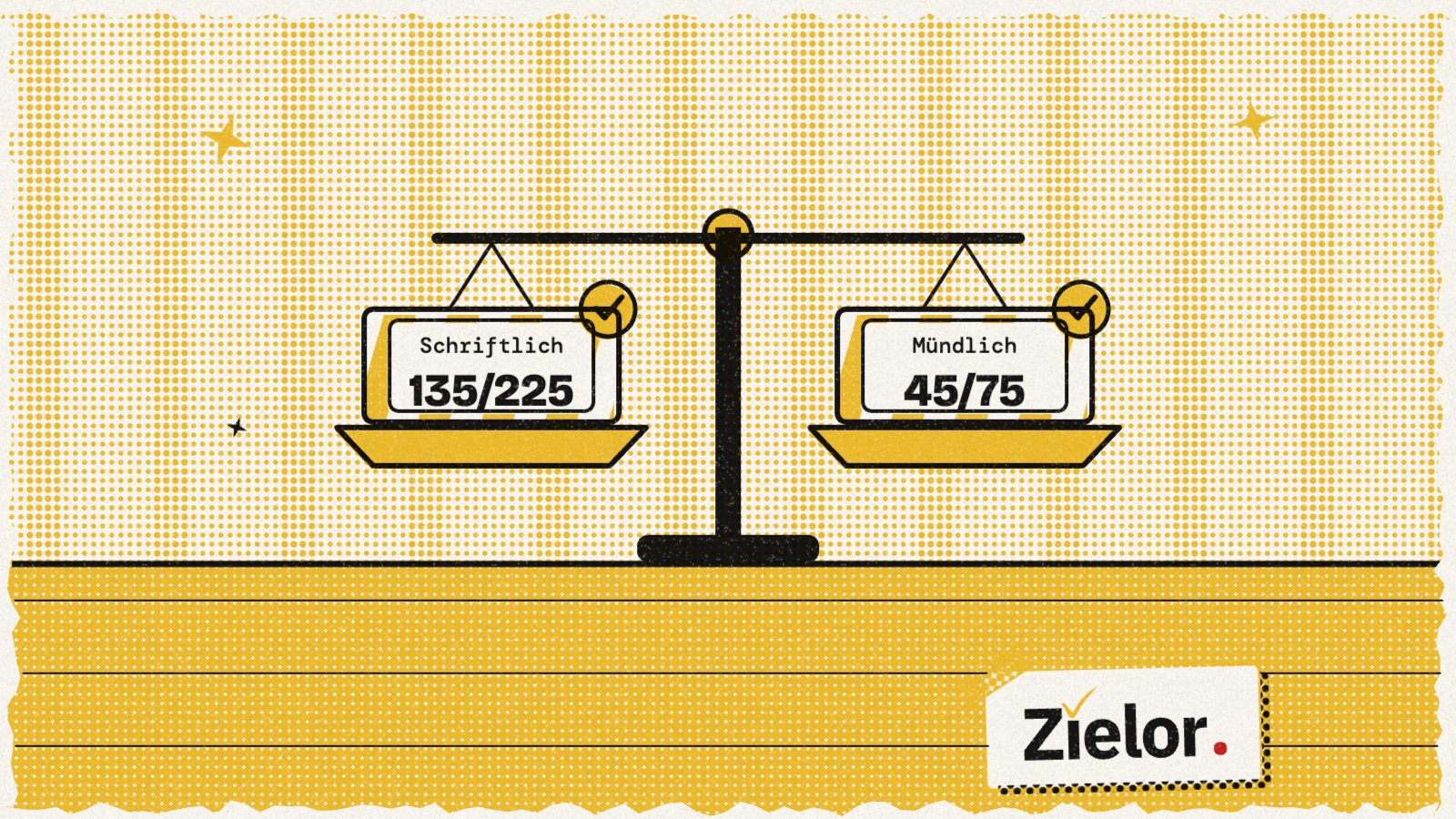
To pass telc B1 (Zertifikat Deutsch) you need 135 of 225 written points and 45 of 75 oral points. Here is how the 300 points are built and why 244 can still fail.
Read the transcript
To pass the telc B1 exam, you need two things. At least 135 of 225 points in the written exam, and at least 45 of 75 points in the oral exam. That is 60 percent in each part. Both lines have to be cleared, and only then are the two results added for your grade out of 300. A strong written result cannot rescue a weak oral result. So 244 points can still be a fail. Four numbers sum it up. 135 of 225 written points. 45 of 75 oral points. 300 points in total. And 60 percent in both parts. The written exam has four subtests. Reading has 3 parts and 20 items, worth 75 points. The language gaps, called Sprachbausteine, have 20 gaps, worth 30 points. Reading and the gaps share 90 minutes. Listening has 20 true or false items in about 30 minutes, worth 75. Writing is one e-mail in 30 minutes, worth 45. Then Speaking takes about 15 minutes for a pair, and is worth 75. A few details are easy to miss. Reading and the gaps share one clock, so plan your own split. Listening part 1 is played only once. Only the answer sheet is scored. And Speaking gives you 20 minutes of preparation. Every part of Reading and Listening is worth 25 points. But the parts have different numbers of items. So one correct answer in Reading part 1 is worth 5 points. In Reading part 2, also 5. In Reading part 3, only 2.5. Each language gap is worth 1.5. In Listening, part 1 is worth 5 per answer, part 2 is worth 2.5, and part 3 is worth 5. So one answer in Reading part 1 is worth more than three language gaps. If time runs short in the shared 90 minutes, finish Reading parts 1 and 2 first. And Listening part 1, the one you hear only once, carries 5 points per answer. Two raters mark your e-mail on three criteria. Task completion, structure and register, and accuracy. Each gets band A, B, C or D, worth 5, 3, 1 or 0 points. The sum is multiplied by three, so the e-mail is worth up to 45. Task completion counts the four points you must cover. All four is band A. Three is band B. Two is band C. So a missing point is the most expensive mistake. And a text that misses the topic scores 0. Band B on all three criteria gives 27. B, B and C gives 21. And band A everywhere gives the full 45. Speaking has three parts. Getting to know each other, discussing a topic, and planning something together. Two examiners rate each part on four criteria. Part 1 is worth at most 15 points. Parts 2 and 3 are worth 30 each, because every band counts double there. Here is what that means. Band C in part 1, and band B in parts 2 and 3, gives 48. That is a pass. Band B in part 1, and band C in parts 2 and 3, gives 27. That is a fail. The discussion and the planning task decide your oral result. The rule is on page 40 of the official practice test. You need 60 percent in both the written and the oral exam. That is 135 and 45 points. Only when both are met are the results added. Here is the check, in order. Do you have at least 135 written points? If not, even 75 in Speaking cannot help. Do you have at least 45 oral points? If not, a strong written part cannot help. If yes, you pass. Inside the written exam, strengths and weaknesses balance out. There is no minimum per subtest, so you can lose 90 points and still clear the line. Let's work one example. Say you score 50 in Reading, 18 in the language gaps, 47.5 in Listening, and 21 in Writing. That is 136.5, just over the line. Nothing from the written exam carries into Speaking. You can lose 30 points there. Mostly band B in parts 2 and 3 is comfortably enough. Mostly band C is not. Now put the two lines together. In the first example, 136.5 written and 48 oral. That is 184.5, a pass. In the second, 200 written and 44 oral. That is 244, and it is not passed, because the oral part is one point short. In the third, 132 written and a perfect 75 oral. That is 207, and not passed. In the fourth, 190 written and 55 oral. That is 245, a good pass. Once both lines are cleared, the grade comes from the total. 270 to 300 is very good. 240 to 269.5 is good. 210 to 239.5 is satisfactory. And 180 to 209.5 is a pass. Because 135 plus 45 is exactly 180, clearing both lines always gives at least a pass. If you fail, you get a results sheet broken down by skill. It tells you which line you missed. If you failed one of the two parts, the written or the oral, you can retake just that part. You have until the end of the following calendar year. Only the retake counts, even if it is lower. And you can always retake the whole exam, as often as you like. Goethe B1 has four separate modules, each passed at 60 of 100, and you retake only the failed module. telc B1 has two parts, and inside the written part a weak skill can be carried by strong ones. So if your Listening is weak but your Reading and grammar are good, telc can be the kinder exam. The common mistake is to rush the language gaps and improvise the e-mail. Both are cheap to fix. The gaps respond directly to grammar practice. And the e-mail loses most points through one missing point of the four. Cover all four, each in at least one clear sentence. To sum up. There are two lines, 135 of 225 written, and 45 of 75 oral. Answers are not worth the same, from 5 points down to 1.5. Parts 2 and 3 decide Speaking. And neither part can rescue the other. The full guide, with the calculator and every official source, is on zielor.com. You can join the waitlist there, to hear when the Zielor app opens. Zielor is independent and not affiliated with telc.
On this page
- What the telc B1 Exam Looks Like
- Not Every Answer Is Worth the Same
- How the E-Mail Is Scored
- How Speaking Is Scored
- The Two Pass Lines
- The Written Line: 135 of 225
- The Oral Line: 45 of 75
- Why 244 Points Can Still Be a Fail
- Grades on the Certificate
- If You Fail One Part
- telc B1 and Goethe B1
- A Mistake to Avoid
- A Study Plan Built on the Two Lines
- Sources
To pass the telc B1 exam (Zertifikat Deutsch / telc Deutsch B1) you need at least 135 of 225 points in the written exam and at least 45 of 75 points in the oral exam. That is 60 percent in each part. Both lines have to be cleared, and only then are the two results added for your grade out of 300.
Two things in the official scoring surprise most people. First, a strong written result cannot rescue a weak oral result, so 244 points can still be a fail. Second, not every correct answer is worth the same. One answer in Reading part 1 is worth 5 points, one gap in the Sprachbausteine only 1.5. This guide shows both, using the scoring pages of the free official Übungstest 1 (practice test) from telc.
Key numbers
The telc B1 rules in four numbers
Four key numbers: 135 of 225 written points, 45 of 75 oral points, 300 points in total, and 60 percent needed in both parts
135
of 225 written points
Reading, Sprachbausteine, Listening, Writing
45
of 75 oral points
the pair exam, on its own
300
points in total
75 percent written, 25 percent oral
60%
in both parts
one part cannot carry the other
Read this figure as text
To pass telc Deutsch B1 (Zertifikat Deutsch) you need 60 percent in the written exam and 60 percent in the oral exam. That is 135 of 225 written points and 45 of 75 oral points. The two results add up to at most 300 points.
What the telc B1 Exam Looks Like
telc Deutsch B1 was developed by telc together with the ÖSD, the Swiss EDK and the Goethe-Institut. It has a written exam with four subtests and an oral exam in pairs. According to telc.net it runs as a digital, hybrid or paper exam.
Exam structure
telc Deutsch B1: five subtests, 300 points
Structure of the telc B1 exam: Reading, Sprachbausteine, Listening, Writing and Speaking, with items, minutes and points
Share of the time per part
-
Leseverstehen (Reading)
- Items
- 20
- Minutes
- 90
- Points
- 75
3 parts of 5, 5 and 10 items; 90 minutes shared with Sprachbausteine
-
Sprachbausteine (language gaps)
- Items
- 20
- Points
- 30
10 grammar and 10 vocabulary gaps
-
Hörverstehen (Listening)
- Items
- 20
- Minutes
- 30
- Points
- 75
3 parts of 5, 10 and 5 true or false items, about 30 minutes
-
Schriftlicher Ausdruck (Writing)
- Items
- 1
- Minutes
- 30
- Points
- 45
one e-mail with 4 points to cover
-
Mündlicher Ausdruck (Speaking)
- Items
- 3
- Minutes
- 15
- Points
- 75
pairs, about 15 minutes, 20 minutes preparation
Total165 Minutes300 Points
Read this figure as text
Reading (Leseverstehen) has 3 parts with 20 items and 75 points. Sprachbausteine (grammar and vocabulary gaps) has 2 parts with 20 items and 30 points; Reading and Sprachbausteine share 90 minutes. Listening (Hörverstehen) has 3 parts with 20 true or false items, about 30 minutes and 75 points. Writing is one e-mail with 4 points to cover, 30 minutes and 45 points. The written exam takes 150 minutes. Speaking is a pair exam of about 15 minutes after 20 minutes of preparation and gives 75 points.
As of 17 October 2026, this is the official structure.
| Subtest | What you do | Items | Time | Points |
|---|---|---|---|---|
| Leseverstehen (Reading) | Match headlines, answer multiple choice on a longer text, match situations to ads | 3 parts: 5, 5 and 10 | 90 minutes, shared with Sprachbausteine | 75 |
| Sprachbausteine (language gaps) | Fill gaps in two texts: grammar (multiple choice), then vocabulary (matching) | 2 parts: 10 and 10 | see above | 30 |
| Hörverstehen (Listening) | True or false on short texts, a conversation and short announcements | 3 parts: 5, 10 and 5 | about 30 minutes | 75 |
| Schriftlicher Ausdruck (Writing) | An informal or semi-formal e-mail covering 4 given points | 1 text | 30 minutes | 45 |
| Mündlicher Ausdruck (Speaking) | Get to know each other, discuss a topic, plan something together | 3 parts | about 15 minutes for a pair, after 20 minutes of preparation | 75 |
The written exam takes 150 minutes in one sitting. Some details are easy to miss.
- Reading and Sprachbausteine share one clock. You get 90 minutes for both together, and nobody tells you when to switch. Plan your own split.
- Listening part 1 is played once. The five short texts in part 1 are heard only once, while the conversation in part 2 and the texts in part 3 are played twice. The recording is not stopped.
- Only the answer sheet counts. Answers are scored from the answer sheet (S30), not from the task booklet.
- No dictionaries or phones in any part.
- Speaking has 20 minutes of preparation. You may make notes on stamped sheets and take them in, but you should not read them out.
Not Every Answer Is Worth the Same
Every part of Reading and Listening is worth 25 points. But the parts have different numbers of items, so the points per answer differ. Zielor worked this out from the official points table.
Chart
What one correct answer is worth
Bar chart of telc B1 points per correct answer: 5 in Reading parts 1 and 2, 2.5 in Reading part 3, 1.5 per Sprachbausteine gap, 5 in Listening parts 1 and 3, 2.5 in Listening part 2
Values in points per correct answer
- Reading part 1 (5 items)5
- Reading part 2 (5 items)5
- Reading part 3 (10 items)2.5
- Sprachbausteine (20 gaps)1.5
- Listening part 1 (5 items)5
- Listening part 2 (10 items)2.5
- Listening part 3 (5 items)5
Read this figure as text
Each part of Reading and Listening is worth 25 points, but the parts have different numbers of items. One correct answer is therefore worth 5 points in Reading part 1 and part 2, 2.5 points in Reading part 3, 5 points in Listening part 1, 2.5 in Listening part 2 and 5 in Listening part 3. Each of the 20 Sprachbausteine gaps is worth 1.5 points. Zielor computed these values from the official points table.
As of 17 October 2026, one correct answer is worth this much.
| Part | Items | Points | Points per answer |
|---|---|---|---|
| Reading part 1 | 5 | 25 | 5 |
| Reading part 2 | 5 | 25 | 5 |
| Reading part 3 | 10 | 25 | 2.5 |
| Sprachbausteine part 1 and 2 | 20 | 30 | 1.5 |
| Listening part 1 | 5 | 25 | 5 |
| Listening part 2 | 10 | 25 | 2.5 |
| Listening part 3 | 5 | 25 | 5 |
Two practical consequences follow. A single answer in Reading part 1 or Listening part 3 is worth more than three Sprachbausteine gaps. So if time runs short in the shared 90 minutes, finishing Reading parts 1 and 2 matters more than polishing the last gaps. And Listening part 1, the one played only once, carries 5 points per answer. Read those five statements before the audio starts.
How the E-Mail Is Scored
The e-mail is marked by two licensed raters. If they differ, the second rating overrules the first. Each of three criteria gets band A, B, C or D, worth 5, 3, 1 or 0 points, and the sum is multiplied by three.
Comparison
How the e-mail reaches 45 points
Comparison of the three telc B1 Writing criteria, what each checks, and the points for bands A to D, multiplied by three
| Row | Aufgabenbewältigung | Kommunikative Gestaltung | Formale Richtigkeit |
|---|---|---|---|
| Checks | the 4 points you must cover | register, structure, connectors | grammar, spelling, punctuation |
| A / B / C / D | 5 / 3 / 1 / 0 | 5 / 3 / 1 / 0 | 5 / 3 / 1 / 0 |
| Band A means | all 4 points covered | right register, linked text | only isolated errors |
| Then | sum x 3 | sum x 3 | sum x 3, at most 45 |
Read this figure as text
The e-mail is rated on three criteria. Aufgabenbewältigung checks the four points you were asked to cover: all four is band A, three is B, two is C, one or none is D. Kommunikative Gestaltung checks register, structure and connectors. Formale Richtigkeit checks grammar, spelling and punctuation. Each criterion gives 5, 3, 1 or 0 points for bands A to D, and the sum is multiplied by three, so the e-mail is worth up to 45 points. A text that misses the topic gets D on every criterion.
The first criterion, Aufgabenbewältigung (task completion), counts the four points the task asks you to cover. All four handled properly is band A, three is B, two is C, one or none is D. A point can be covered in one short sentence, so a missing point is the most expensive mistake in the e-mail. If the text has nothing to do with the task, every criterion gets D and the e-mail scores 0.
Some sums to picture it:
- Band B on all three criteria gives 9 x 3 = 27 of 45.
- B, B and C gives 7 x 3 = 21.
- Band A everywhere gives the full 45.
How Speaking Is Scored
Two examiners rate you independently on four criteria in each part: expression (Ausdrucksfähigkeit), task management (Aufgabenbewältigung), accuracy (Formale Richtigkeit) and pronunciation (Aussprache und Intonation). After you leave the room, they agree on a joint rating.
Comparison
Where the 75 Speaking points come from
Comparison of the three telc B1 Speaking parts: maximum points 15, 30 and 30, and what band B or band C on every criterion gives
| Row | Part 1 | Part 2 | Part 3 | Total |
|---|---|---|---|---|
| Task | get to know each other | discuss a topic | plan something together | about 15 minutes |
| Maximum | 15 | 30 | 30 | 75 |
| Band B everywhere | 11 | 22 | 22 | 55, pass |
| Band C everywhere | 4 | 8 | 8 | 20, fail |
Read this figure as text
Each Speaking part is rated on four criteria in bands A to D. Part 1, getting to know each other, is worth at most 15 points. Part 2, discussing a topic, and part 3, planning something together, are worth 30 each. Band B on every criterion gives 11, 22 and 22, which is 55 and a pass. Band C on every criterion gives 4, 8 and 8, which is 20 and a fail.
Part 1 is short and worth at most 15 points. Parts 2 and 3 are worth 30 each, because every band counts double there. That has a clear effect.
- Band C in part 1 and band B in parts 2 and 3 gives 4 + 22 + 22 = 48. Pass.
- Band B in part 1 and band C in parts 2 and 3 gives 11 + 8 + 8 = 27. Fail.
The discussion and the planning task decide your oral result. Part 1 is a warm up worth a fifth of the points.
The Two Pass Lines
The rule on page 40 of the Übungstest is short. You need 60 percent of the maximum in both the written and the oral exam, which is 135 and 45 points. Only when both are met are the two results added.
Pass rule
Did you pass telc B1?
Decision flow for the telc B1 pass rule: at least 135 of 225 written points and at least 45 of 75 oral points
-
At least 135 of 225 points in the written exam?
NoNot passed
Even 75 of 75 in Speaking cannot help; retake the written part
Yes -
At least 45 of 75 points in the oral exam?
YesPassed
Both results are added for the grade, at least 180 of 300
NoNot passed
A strong written part cannot help; retake the oral part
Read this figure as text
First, the written exam needs at least 135 of 225 points. Second, the oral exam needs at least 45 of 75 points. Only if both are met is the exam passed and the two results added for the grade. A part that was failed or not taken can be retaken on its own in the same or the following calendar year.
The Written Line: 135 of 225
Within the written exam, strengths and weaknesses balance out. There is no minimum per subtest, so you can lose 90 points across Reading, Sprachbausteine, Listening and Writing together and still clear the line. Try your own numbers.
Score calculator
Written exam: have you cleared the 135 point line?
Calculator for the telc B1 written exam: points in Reading, Sprachbausteine, Listening and Writing, 135 of 225 to clear the line
Worked example
| Part | Points | Max |
|---|---|---|
| Reading (points of 75) | 50 | 75 |
| Sprachbausteine (points of 30) | 18 | 30 |
| Listening (points of 75) | 47.5 | 75 |
| Writing (points of 45) | 21 | 45 |
- Raw points
- 136.5
- times 1
- 136.5
- Score, not rounded
- 136.5 of 225
136.5of 225
Pass mark 135
Written line cleared
Read this figure as text
Enter your points in Reading (of 75), Sprachbausteine (of 30), Listening (of 75) and Writing (of 45). The calculator adds them and checks the sum against 135 of 225. The worked example of 50, 18, 47.5 and 21 gives 136.5, which clears the line. Speaking is checked separately against 45 of 75.
The worked example is 50 points in Reading (4 answers right in part 1, 3 in part 2, 6 in part 3), 18 in Sprachbausteine (12 gaps right), 47.5 in Listening (3, 7 and 3 right) and 21 in Writing (bands B, B and C). That is 136.5, just over the line.
The Oral Line: 45 of 75
Nothing from the written exam carries into Speaking. You can lose 30 points, and the band sums above show where they go: mostly band B in parts 2 and 3 is comfortably enough, mostly band C is not.
Why 244 Points Can Still Be a Fail
As of 17 October 2026, these worked examples show how the two lines interact.
Comparison
Why 244 points can still be a fail
Four worked telc B1 results showing written points, oral points, total and result, including 244 points that fail
| Row | Written | Oral | Total | Result |
|---|---|---|---|---|
| Example 1 | 136.5 | 48 | 184.5 | Passed, ausreichend |
| Example 2 | 200 | 44 | 244 | Not passed, oral below 45 |
| Example 3 | 132 | 75 | 207 | Not passed, written below 135 |
| Example 4 | 190 | 55 | 245 | Passed, gut |
Read this figure as text
136.5 written and 48 oral give 184.5, a pass with ausreichend. 200 written and 44 oral give 244, but the exam is not passed because the oral part is one point below 45. 132 written and a perfect 75 oral give 207, not passed because the written part is below 135. 190 written and 55 oral give 245, a pass with gut.
| Written | Oral | Total | Result |
|---|---|---|---|
| 136.5 | 48 | 184.5 | Passed, ausreichend |
| 200 | 44 | 244 | Not passed, oral below 45 |
| 132 | 75 | 207 | Not passed, written below 135 |
| 190 | 55 | 245 | Passed, gut |
Rows two and four both sit in the "gut" range. One is a good pass and the other is a fail, because the oral result is one point short. Row three is the mirror case: a perfect oral result cannot rescue a written result of 132.
Grades on the Certificate
Once both lines are cleared, the grade comes from the total out of 300.
Chart
Points needed for each grade
Bar chart of the minimum total for each telc B1 grade: 180 ausreichend, 210 befriedigend, 240 gut, 270 sehr gut
Values in points of 300, at least
- Ausreichend (pass)180
- Befriedigend (satisfactory)210
- Gut (good)240
- Sehr gut (very good)270
Read this figure as text
Once both lines are cleared, the written and oral results are added. 180 to 209.5 is ausreichend (pass), 210 to 239.5 befriedigend (satisfactory), 240 to 269.5 gut (good) and 270 to 300 sehr gut (very good).
270 to 300 is sehr gut (very good), 240 to 269.5 gut (good), 210 to 239.5 befriedigend (satisfactory) and 180 to 209.5 ausreichend (pass). Because 135 plus 45 is exactly 180, clearing both lines always gives at least ausreichend.
Results are worked out centrally at telc. If you pass you get a certificate. If you fail you get a results sheet broken down by skill, which tells you which line you missed.
If You Fail One Part
This is where telc differs from a single all or nothing exam. If you failed or missed one of the two parts, the written or the oral, you can retake just that part in the same calendar year or the following one. Two rules come with it:
- Only the retake counts. The result of the retake replaces the old one for good, even if it is lower.
- The deadline is the calendar year, not twelve months. A part failed in November 2026 can be retaken until the end of 2027.
You can also retake the whole exam as often as you like. Ask your exam centre for dates; telc runs its exams through licensed centres.
telc B1 and Goethe B1
Both are general B1 exams, and both are on the BAMF list of recognised B1 certificates. The scoring logic is different. Goethe B1 has four separate modules, each passed at 60 of 100, and you retake only the failed module. telc B1 has two parts, and inside the written part a weak skill can be carried by strong ones. So if your Listening is weak but your Reading and grammar are good, telc can be the kinder exam. If one skill is far below the others and you want to retake only that skill, Goethe's modules fit better. A full comparison with the DTZ, in German, is in B1-Prüfung: Goethe, telc oder DTZ?.
Whether an office, employer or university accepts telc B1 for your purpose is its decision. Check the wording of your requirement: some ask for a level, some for a named certificate.
A Mistake to Avoid
The common mistake is to treat the Sprachbausteine as the part to rush and the e-mail as the part to improvise. Both are cheap to fix. Sprachbausteine respond directly to grammar practice, and the e-mail loses most of its points through one missing point of the four. Cover all four, each in at least one clear sentence, and you protect up to 15 of the 45 points before style even matters.
A Study Plan Built on the Two Lines
If I were preparing for telc B1, I would plan around the two lines and the points per answer.
- Sit the free Übungstest under real timing, with your own split of the 90 minutes. Score it with the points per answer above, not by counting right answers.
- Set the written target at 150, not 135. Fifteen extra points cover one bad Listening part.
- Train Listening part 1 for one hearing only. Five answers worth 5 points each, played once.
- Lock in the e-mail. Plan the four points first, then write. Match the register of the e-mail you are answering.
- Train parts 2 and 3 of Speaking with a partner, out loud. They carry 60 of the 75 oral points. Use the 20 minutes of preparation for key phrases, not full sentences to read.
Zielor is a German exam practice app in development, independent of telc. If you would like to try it when it opens, you can join the waitlist on this site.
How this article was made: drafted with AI assistance from the official documents linked above and checked by Kevin Gabeci.