
telc B2 Exam: Points per Answer and the Two Pass Lines
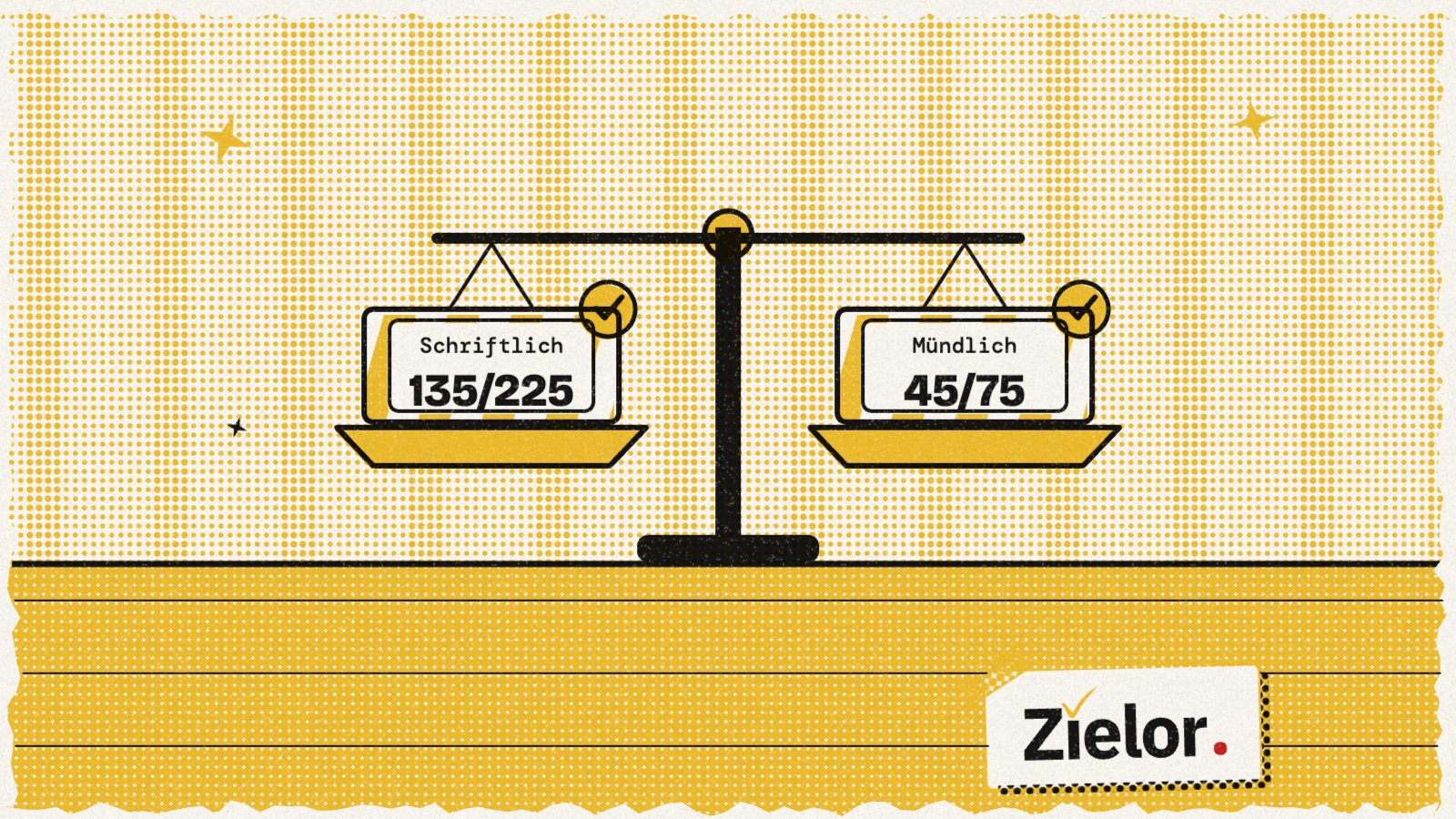
To pass telc B2 you need 135 of 225 written points and 45 of 75 oral points. How the 300 points are built, what each answer is worth, and why 248 can fail.
On this page
- The telc Deutsch B2 Exam at a Glance
- What One Answer Is Worth
- How the E-Mail Is Scored
- How Speaking Is Scored
- The Two Pass Lines
- The Written Line: 135 of 225
- The Oral Line: 45 of 75
- Why 248 Points Can Still Be a Fail
- Grades on the Certificate
- If You Miss One Line: The 12 Month Rule
- What You May Bring Into the Room
- telc B2, Goethe B2 and the Job Exams
- Coming From telc B1
- A Study Plan Built on the Numbers
- Sources
To pass the telc B2 exam (telc Deutsch B2) you need at least 135 of 225 points in the written exam and at least 45 of 75 points in the oral exam. Both lines have to be cleared on their own. Only then are the two results added for a grade out of 300, so a total of 248 can still be a fail.
The pass lines are the same as at telc B1, but almost everything around them changes. All three listening texts are played only once. The e-mail asks for three points instead of four, and each one needs more than a single sentence. In Speaking, every part now counts the same. This guide works through all of it from the free official Übungstest 1, which telc says is also the Modelltest (model test) for the exam, and from telc's current exam regulations.
Key numbers
telc B2 in four numbers
Four key numbers for telc Deutsch B2: 135 of 225 written points, 45 of 75 oral points, 140 minutes of written exam, and every listening text played once
135
of 225 written points
Reading, Sprachbausteine, Listening, Writing
45
of 75 oral points
checked on its own
140
minutes written exam
90 + about 20 + 30, no break
1x
each listening text
all three parts, no second play
Read this figure as text
To pass telc Deutsch B2 you need at least 135 of 225 points in the written exam and at least 45 of 75 points in the oral exam, 60 percent in each. The written exam takes 140 minutes in one sitting. All three listening parts are played only once.
The telc Deutsch B2 Exam at a Glance
telc describes telc Deutsch B2 as its exam for general German at an advanced level. According to the telc.net exam page, it runs as a digital, hybrid or paper exam. On paper you mark your answers on an answer sheet. In the digital exam you type them into the exam software.
Exam structure
telc Deutsch B2: five subtests, 300 points
Structure of telc Deutsch B2: Reading, Sprachbausteine, Listening, Writing and Speaking, with items, minutes and points
Share of the time per part
-
Leseverstehen (Reading)
- Items
- 20
- Minutes
- 90
- Points
- 75
3 parts of 5, 5 and 10 items; 90 minutes shared with Sprachbausteine
-
Sprachbausteine (language gaps)
- Items
- 20
- Points
- 30
10 grammar gaps (a, b or c), 10 vocabulary gaps from a box of 15 words
-
Hörverstehen (Listening)
- Items
- 20
- Minutes
- 20
- Points
- 75
3 parts of 5, 10 and 5 true or false items, each played once
-
Schriftlicher Ausdruck (Writing)
- Items
- 1
- Minutes
- 30
- Points
- 45
choose task A or B, cover 3 points, at least 150 words
-
Mündlicher Ausdruck (Speaking)
- Items
- 3
- Minutes
- 15
- Points
- 75
pairs, about 15 minutes, 20 minutes preparation
Total155 Minutes300 Points
Read this figure as text
Reading (Leseverstehen) has 3 parts with 5, 5 and 10 items and is worth 75 points. Sprachbausteine has 2 parts with 10 gaps each and is worth 30 points. Reading and Sprachbausteine share 90 minutes. Listening (Hörverstehen) has 3 parts with 5, 10 and 5 true or false items, takes about 20 minutes and is worth 75 points. Writing is one semi-formal e-mail in 30 minutes, worth 45 points. Speaking is a pair exam of about 15 minutes after 20 minutes of preparation, worth 75 points.
As of 28 October 2026, this is the official structure.
| Subtest | What you do | Items | Time | Points |
|---|---|---|---|---|
| Leseverstehen (Reading) | Match 5 texts to 10 headlines, answer multiple choice on two articles, match 10 situations to 12 short notices | 3 parts: 5, 5 and 10 | 90 minutes, shared with Sprachbausteine | 75 |
| Sprachbausteine (language gaps) | Grammar gaps with three options, then vocabulary gaps from a box of 15 words | 2 parts: 10 and 10 | see above | 30 |
| Hörverstehen (Listening) | True or false on a news broadcast, a radio interview and five short announcements | 3 parts: 5, 10 and 5 | about 20 minutes | 75 |
| Schriftlicher Ausdruck (Writing) | Pick task A or B and write a semi-formal e-mail, at least 150 words | 1 text | 30 minutes | 45 |
| Mündlicher Ausdruck (Speaking) | Talk about an experience, discuss a text, plan something together | 3 scored parts | about 15 minutes for a pair, after 20 minutes of preparation | 75 |
The written exam runs 140 minutes in one block. A few details from the Übungstest are worth knowing before you sit it.
- You manage the 90 minutes yourself. Reading and Sprachbausteine share one clock, and nobody announces when to switch.
- Reading part 3 has an empty answer. Ten situations, twelve notices, and sometimes no notice fits, in which case you mark x.
- Listening is played once, every part. You get 30 seconds to read the statements for part 1 and 60 seconds for part 2. The recording is not stopped.
- The task number on your writing paper matters. Before you start writing, you copy the number of your writing task onto page 5 of the answer sheet. If it is missing or wrong, the writing cannot be marked and scores zero.
What One Answer Is Worth
Each part of Reading and Listening is worth 25 points, and each part of Sprachbausteine 15. The parts have different numbers of items, so one correct answer is worth different amounts. Zielor divided the points of each part by its items.
Chart
What one correct answer is worth
Bar chart of telc B2 points per correct answer: 5 in Reading parts 1 and 2, 2.5 in Reading part 3, 1.5 per Sprachbausteine gap, 5 in Listening parts 1 and 3, 2.5 in Listening part 2
Values in points per correct answer
- Reading part 1 (5 items)5
- Reading part 2 (5 items)5
- Reading part 3 (10 items)2.5
- Sprachbausteine part 1 (10 gaps)1.5
- Sprachbausteine part 2 (10 gaps)1.5
- Listening part 1 (5 items)5
- Listening part 2 (10 items)2.5
- Listening part 3 (5 items)5
Read this figure as text
Every Reading and Listening part is worth 25 points and every Sprachbausteine part 15, but the parts have different numbers of items. One correct answer is worth 5 points in Reading parts 1 and 2, 2.5 in Reading part 3, 1.5 in each Sprachbausteine part, 5 in Listening part 1, 2.5 in Listening part 2 and 5 in Listening part 3. Zielor computed these values from the official points table.
As of 28 October 2026, one correct answer is worth this much.
| Part | Items | Points | Points per answer |
|---|---|---|---|
| Reading part 1 | 5 | 25 | 5 |
| Reading part 2 | 5 | 25 | 5 |
| Reading part 3 | 10 | 25 | 2.5 |
| Sprachbausteine part 1 | 10 | 15 | 1.5 |
| Sprachbausteine part 2 | 10 | 15 | 1.5 |
| Listening part 1 | 5 | 25 | 5 |
| Listening part 2 | 10 | 25 | 2.5 |
| Listening part 3 | 5 | 25 | 5 |
The spread is wide. One headline in Reading part 1 is worth more than three Sprachbausteine gaps together. That gives the 90 minutes a clear order. Reading parts 1 and 2 come first, because each answer there is worth 5, then Reading part 3, then the gaps.
Listening is where B2 bites, and I think it's the single biggest change from B1. Parts 1 and 3 carry 5 points per answer and you hear them once. The news broadcast in part 1 is dense, so the 30 seconds of reading time before it are the most valuable half minute of the exam. Use them to underline the one word in each statement that the audio has to confirm or contradict.
How the E-Mail Is Scored
You choose between two tasks at the start of the 30 minutes. In the Übungstest they are a request for information and a complaint. Each task lists four points, and you cover three of them, or two plus an aspect of your own that fits the situation. The task asks for at least 150 words.
Comparison
How the B2 e-mail reaches 45 points
Comparison of the three telc B2 writing criteria, what each checks, what band A needs, and the points for bands A to D
| Row | Aufgabenbewältigung | Kommunikative Gestaltung | Formale Richtigkeit |
|---|---|---|---|
| Checks | the 3 points you chose | register, links, vocabulary | grammar, spelling, punctuation |
| Band A needs | 3 points, each in more than one sentence | B2 in its upper range | B2 in its upper range |
| A / B / C / D | 5 / 3 / 1 / 0 | 5 / 3 / 1 / 0 | 5 / 3 / 1 / 0 |
| Then | sum x 3 | sum x 3 | sum x 3, at most 45 |
Read this figure as text
The e-mail is rated on three criteria. Aufgabenbewältigung counts the points you handle: three points, or two plus an aspect of your own, is band A, two is B, one is C, none is D, and each point needs more than one sentence. Kommunikative Gestaltung checks register, links between ideas and range of vocabulary. Formale Richtigkeit checks grammar, spelling and punctuation. Each criterion gives 5, 3, 1 or 0 points for bands A to D, and the sum is multiplied by three, so the e-mail is worth up to 45 points.
Two licensed raters mark the text, and if they disagree, the second rating overrules the first. They use three criteria.
- Aufgabenbewältigung (task completion). Three points handled properly is band A, two is B, one is C, none is D. The rating guide says a point needs more than a single sentence to count as handled. This is the trap for anyone who passed B1 by ticking off each point in one line. If I could drill only one writing habit before the exam, it would be this one.
- Kommunikative Gestaltung (register and coherence). Band A is B2 in its upper range, B is B2, C is B1 level, D is A2 or below. You lose A if the e-mail has no subject line, greeting or closing and the vocabulary is thin. You lose B if the register is wrong or wobbles, or if the points are simply listed one after another without links.
- Formale Richtigkeit (accuracy). The same four levels, applied to grammar, spelling and punctuation.
Each criterion gives 5, 3, 1 or 0 points, and the sum is multiplied by three. Some sums to make it concrete:
- Band B on all three gives 9 x 3 = 27 of 45.
- B, B and C gives 7 x 3 = 21.
- A, B and B gives 11 x 3 = 33.
- Miss the topic entirely and every criterion gets D, so 0.
There is a quieter way to lose points. If you answer the topic but miss the situation (the guide's example is writing a job application when the task asked you to request information about an internship), only the first criterion drops to D. The other two are still rated, so you keep up to 30 of the 45 points. And telc's regulations say that a text built from memorised model texts, even lightly reworded, is scored as zero at the very least.
How Speaking Is Scored
The oral exam is normally done in pairs. It opens with a short getting-to-know-you round of about a minute that is not scored. Then come three parts of about five minutes each.
- Part 1, talking about an experience. You pick one of seven topics, usually prepared at home, and speak for up to a minute and a half. Then your partner asks you questions, and you swap.
- Part 2, discussion. You read a text in the preparation room. In the exam you comment on it briefly, at most a minute, then argue it out with your partner.
- Part 3, planning something together. You plan an event or trip with your partner, making and answering suggestions.
Two examiners rate each part independently on four criteria and agree on a joint rating after you leave the room. Expression, task management and accuracy give 7, 5, 3 or 0 points for bands A to D. Pronunciation gives 4, 2, 1 or 0. That is 25 per part, and unlike B1, where the first part was a 15 point warm up, all three B2 parts weigh the same.
Comparison
Where the 75 Speaking points come from
Comparison of telc B2 speaking results: points per part and in total for band A, band B, band B with C in accuracy, and band C everywhere
| Row | Per part | Three parts | Result |
|---|---|---|---|
| Band A everywhere | 25 | 75 | pass |
| Band B everywhere | 17 | 51 | pass |
| B, but C in accuracy | 15 | 45 | pass, no margin |
| Band C everywhere | 10 | 30 | fail |
Read this figure as text
Each of the three scored Speaking parts is worth 25 points: up to 7 for expression, 7 for task management, 7 for accuracy and 4 for pronunciation. Band B on every criterion gives 17 per part and 51 in total, a pass. Band B with C only in accuracy gives 15 per part and exactly 45, a pass with no margin. Band C everywhere gives 10 per part and 30 in total, a fail.
The arithmetic has one sharp edge. Band B everywhere gives 17 per part and 51 in total, a comfortable pass. Let accuracy drop to C in every part while everything else stays at B, and you are at 15 per part, which is 45, exactly on the line. Let pronunciation slip to C as well and it is 14 per part and 42, a fail. So the difference between passing and failing an otherwise solid B performance can be the 1 point between a B and a C in pronunciation, three times over. Small, and decisive. I wouldn't treat pronunciation as a detail for the last week.
The examiners are also told to watch for memorised speeches, which is most tempting in part 1 because you prepare it at home. If a talk sounds recited, they interrupt and steer you with questions. Notes are another limit. For parts 2 and 3 you prepare for 20 minutes and may write only on stamped sheets from the centre. Only those notes go into the room, and you are not supposed to read from them.
The Two Pass Lines
The rule on page 46 of the Übungstest is short. You need 60 percent of the maximum in the written exam and in the oral exam, which is 135 and 45 points. If both are met, the two results are added.
Pass rule
Did you pass telc B2, and what do you retake?
Decision flow for the telc B2 pass rule: at least 135 of 225 written points and at least 45 of 75 oral points, with what to retake in each case
-
At least 135 of 225 points in the written exam?
Yes -
At least 45 of 75 points in the oral exam?
YesPassed
Both results are added for the grade, at least 180 of 300
NoNot passed
Retake only the oral exam within 12 months
-
At least 45 of 75 points in the oral exam?
YesNot passed
Retake only the written exam within 12 months
NoNot passed
Retake the whole exam
Read this figure as text
First, the written exam needs at least 135 of 225 points. Then the oral exam needs at least 45 of 75. If both lines are met, the exam is passed and the two results are added for the grade. If only one line is missed, that part alone can be retaken within twelve months of the results sheet, as long as you ask for the passed part to be credited when you register. If both are missed, the whole exam is taken again.
The Written Line: 135 of 225
Inside the written exam there is no minimum per subtest. You can lose 90 points across Reading, Sprachbausteine, Listening and Writing together, so a weak skill can be carried by the others. Try your own numbers.
Score calculator
Written exam: have you cleared 135?
Calculator for the telc B2 written exam: points in Reading, Sprachbausteine, Listening and Writing, 135 of 225 to clear the line
Worked example
| Part | Points | Max |
|---|---|---|
| Reading (points of 75) | 50 | 75 |
| Sprachbausteine (points of 30) | 19.5 | 30 |
| Listening (points of 75) | 45 | 75 |
| Writing (points of 45) | 21 | 45 |
- Raw points
- 135.5
- times 1
- 135.5
- Score, not rounded
- 135.5 of 225
135.5of 225
Pass mark 135
Written line cleared
Read this figure as text
Enter your points in Reading (of 75), Sprachbausteine (of 30), Listening (of 75) and Writing (of 45). The calculator adds them and checks the sum against 135 of 225. The worked example of 50, 19.5, 45 and 21 gives 135.5, half a point above the line. Speaking is checked separately against 45 of 75.
The worked example in the calculator is 50 points in Reading (4, 3 and 6 right in the three parts), 19.5 in Sprachbausteine (13 gaps right), 45 in Listening (3, 6 and 3 right) and 21 in Writing (bands B, B and C). That is 135.5, half a point above the line. It also shows how fragile a borderline result is. One more wrong answer in Listening part 1 would have cost 5 points, and the result would have dropped to 130.5. Fail.
The Oral Line: 45 of 75
Nothing from the written exam carries over. You can lose 30 points in Speaking, and the band sums above show what that means. Solid B is safe, B with a weak spot in accuracy is on the line, and one part that slips to C throughout (17 + 17 + 10 = 44) is already a fail.
Why 248 Points Can Still Be a Fail
As of 28 October 2026, these worked examples show how the two lines interact. The component scores are possible combinations under the official points table.
| Written | Oral | Total | Result |
|---|---|---|---|
| 135.5 | 45 | 180.5 | Passed, ausreichend |
| 206 | 42 | 248 | Not passed, oral below 45 |
| 133 | 66 | 199 | Not passed, written below 135 |
| 168 | 51 | 219 | Passed, befriedigend |
| 140 | 44 | 184 | Not passed, oral below 45 |
Row two is the one I'd remember. 248 would be a "gut" if the oral result were 3 points higher. Row three is its mirror. A strong oral result does nothing for a written exam 2 points short. Row five is the quiet version of row two. Its 184 is above the 180 where the lowest grade starts, and it still fails. The written 140 is 50 in Reading (4 right in each part), 18 in Sprachbausteine (12 gaps), 45 in Listening and 27 for an all-B e-mail. The oral 44 is band B in two Speaking parts and band C in the third, 17 + 17 + 10, one point short.
Grades on the Certificate
Once both lines are cleared, the grade comes from the total.
| Total of 300 | Grade |
|---|---|
| 270 to 300 | sehr gut (very good) |
| 240 to 269.5 | gut (good) |
| 210 to 239.5 | befriedigend (satisfactory) |
| 180 to 209.5 | ausreichend (pass) |
Because 135 plus 45 is 180, anyone who clears both lines gets at least ausreichend. Results are worked out centrally at telc. A pass gets a certificate. A fail gets a results sheet broken down by skill, which shows which line you missed. The certificate itself carries no expiry date. Whether an older one is still accepted is up to whoever asks for it.
If You Miss One Line: The 12 Month Rule
Here telc's rules have moved on from the practice test. It matters for your planning. The Übungstest, printed in 2021, says a failed part can be retaken in the same or the following calendar year. telc's current Prüfungsordnung (exam regulations), valid from 15 April 2025, sets a different window, and it is the one I would plan around.
- Twelve months, counted from the results sheet. If you failed the written or the oral exam, you can retake just that part within twelve months of the date your results sheet was issued.
- Whole parts only. You retake the full written exam or the full oral exam. Retaking only Listening, say, is not allowed.
- Say so when you register. The request to credit the part you passed has to be made when you book the retake. The fee list in the regulations also names a later crediting (nachträgliche Anrechnung) within one year of the results sheet for 40 euros, so if you missed that step, ask your centre about it.
- The latest result counts. The credit is applied to your most recent result.
The appendix of the regulations confirms that crediting works for exams at B1, B2, C1 and C2, and not for exams scaled over two levels such as telc Deutsch B1·B2 Beruf. You can also retake the whole exam as often as you like. Your centre handles the booking and sets its own prices and conditions, so ask it how it applies the rule before you pay.
What You May Bring Into the Room
The Prüfungsordnung is specific. You need a valid official photo ID. Arrive early, because anyone who turns up after the briefing has begun may not take part. On the desk you may have pencils, pens, a sharpener, an eraser, tissues and a drink in a clear bottle with no label. Jackets, bags, phones and wrist watches are handed in before the exam. Dictionaries, textbooks, your own notes and any device that can store or send information, including smart watches and smart glasses, are not allowed at any time. Bring a soft pencil for the answer sheet, which the Übungstest recommends for marking the answer fields.
telc B2, Goethe B2 and the Job Exams
Goethe B2 splits the same four skills into four separate modules. Each is scored out of 100 and passed at 60 on its own, and a module can be retaken by itself as often as the centre can fit you in. telc B2 has only two lines, written and oral, and inside the written exam a weak skill can be carried by strong ones. If your Listening is shaky but your Reading and grammar are good, telc's structure is the kinder one. If one skill is far below the rest and you want the option to retake only that skill, Goethe's modules fit better.
Two telc exams with similar names are different products. telc Deutsch B1·B2 Beruf is a job-related exam scaled over B1 and B2. Every part has tasks at both levels, and your result decides whether the certificate says B1 or B2. It cannot be taken as a partial exam. The Deutsch-Test für den Beruf B2 (DTB) is the final exam of the job-related German courses (Berufssprachkurse) whose content the BAMF oversees. Only BAMF-authorised centres run it, and course providers register their participants. If nobody has asked you for a job-related exam, telc Deutsch B2 is the general one.
Whether an employer, university or office accepts telc B2 for your purpose is its decision. One public example concerns nurses. Hessen's nursing recognition authority lists telc Deutsch B2 among the accepted certificates. The state by state picture is in our guide German for nurses.
Coming From telc B1
If you passed telc B1, the 135 and 45 will look familiar, and the points per answer in Reading and Listening are the same. Four things change, and each one costs points if you prepare the B1 way.
- Listening loses its second hearing. At B1 only part 1 was played once. At B2 all three parts are.
- The written exam is 10 minutes shorter, 140 minutes instead of 150.
- The e-mail asks for less but deeper. Three points instead of four, but one sentence per point is no longer enough.
- Speaking part 1 now counts fully. It is worth 25, like the discussion and the planning task, instead of 15.
A Study Plan Built on the Numbers
If I were preparing for telc B2, I would plan around the two lines and the one-hearing rule.
- Sit the free Übungstest under exam timing. It is on telc.net with the audio. Play each recording once, then score it with the points per answer above, not by counting right answers.
- Aim for 150 written, not 135. Fifteen points of margin is three answers in Listening part 1.
- Train Listening on single plays only. News and radio interviews, once, with 30 seconds to read the questions first.
- Write the e-mail in paragraphs, one per point. Two or three sentences each, joined with connectors, plus a subject line, greeting and closing. That protects the first two criteria before grammar even matters.
- Prepare the part 1 topic as notes, not a script. A speech that sounds recited gets interrupted. Practise parts 2 and 3 aloud with a partner, because asking back and helping each other count in your favour.
Zielor is a German exam practice app in development, independent of telc. Its practice uses the same task types as the real exam, written by Zielor. If you would like to try it when it opens, you can join the waitlist on this site.
How this article was made. Drafted with AI assistance from the official documents linked above, with every number checked against them on 28 October 2026 by Kevin Gabeci. The points per answer, band sums and worked results are Zielor's own calculations from the official tables.
Sources
- telc: telc Deutsch B2, Übungstest 1 (10th edition, 2021), also the Modelltest
- telc: telc Deutsch B2 exam page
- telc: Prüfungsordnung, valid from 15 April 2025
- telc: telc Deutsch B1·B2 Beruf exam page
- telc: Deutsch-Test für den Beruf
- Goethe-Institut: Goethe-Zertifikat B2 Terms and Conditions for Exam Administration (1 September 2025)
- telc: Zertifikat Deutsch / telc Deutsch B1, Übungstest 1 (14th edition, 2021)
- HLfGP Hessen: Recognition of foreign nursing qualifications